
FEMALE REPRODUCTIVE ORGANS (ANATOMICAL MICROSCOPY)
10.14
Descending clitoral body
Specimen
Specimen details:
Organ: Clitoris
Origin: Human
Staining: Hematoxylin Eosin (H&E)
Method and Specimen Description:
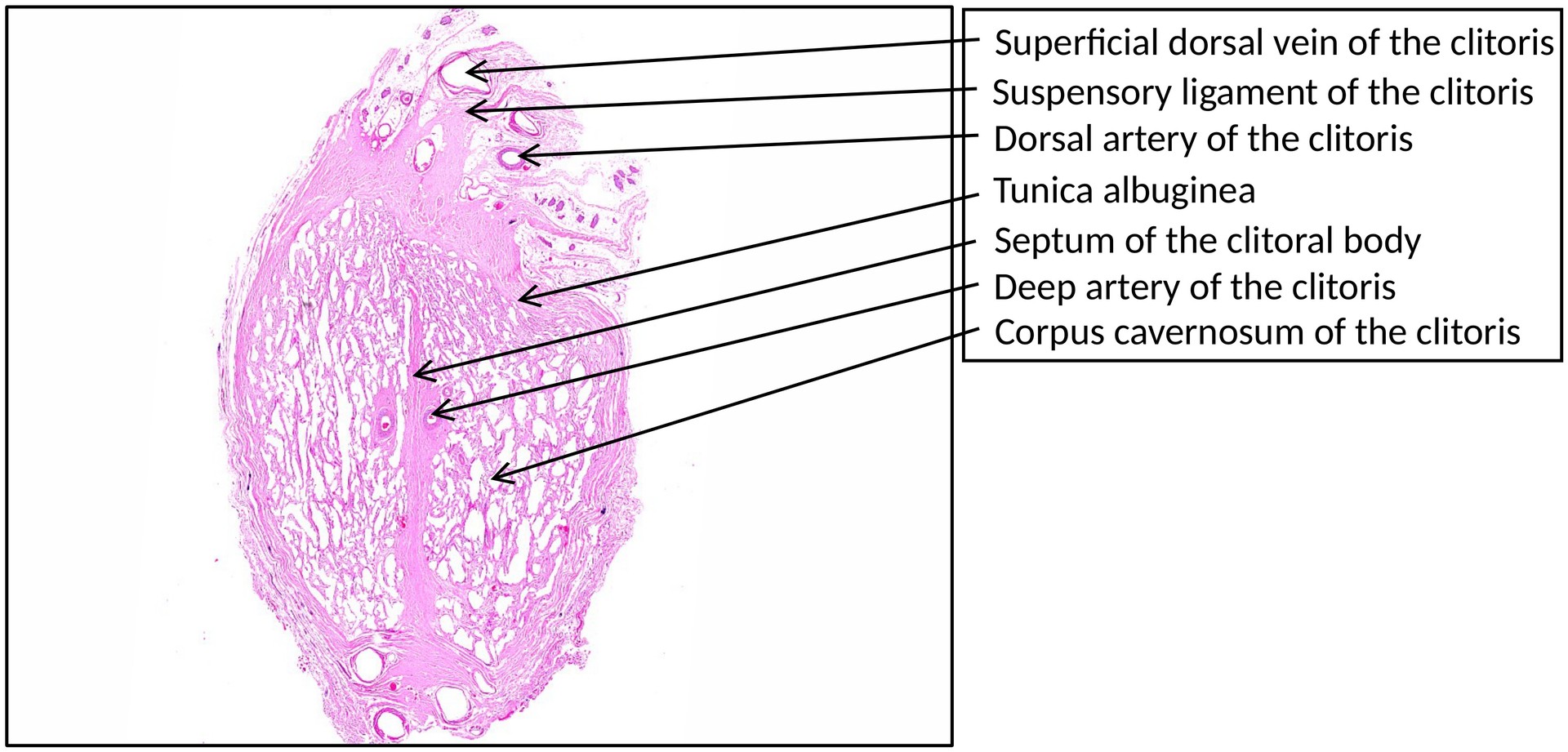
Cross-section through the descending part of the human clitoral body.
Objective of the Examination:
To study the structure and organization of the cavernous body of the clitoris.
Special Features of the Specimen:
General:
The clitoris is a highly vascular erectile organ that develops from the same embryological primordium as the male penis. It consists of:
-
Paired corpora cavernosa clitoridis (cavernous bodies),
-
A smaller glans clitoridis, and
-
The prepuce (clitoral hood).
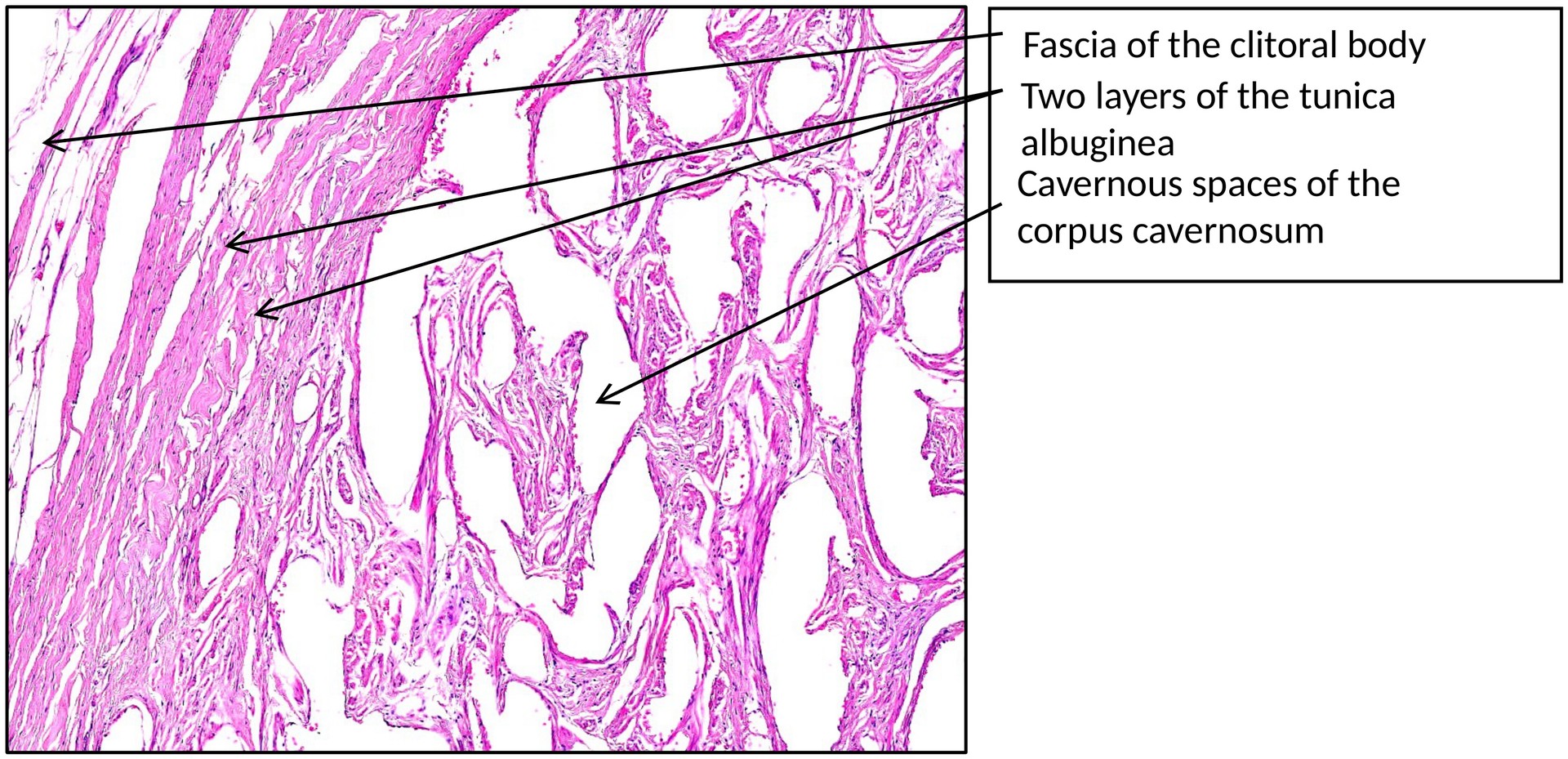
The corpora cavernosa are paired cylindrical structures of erectile tissue, each surrounded by a dense fibrous capsule (tunica albuginea) and enclosed by a fibroelastic fascia. The cavernous tissue is composed of irregular cavernous spaces (sinusoids) lined by endothelium and separated by trabeculae containing smooth muscle fibres, fibroblasts, elastic fibres, and blood vessels.
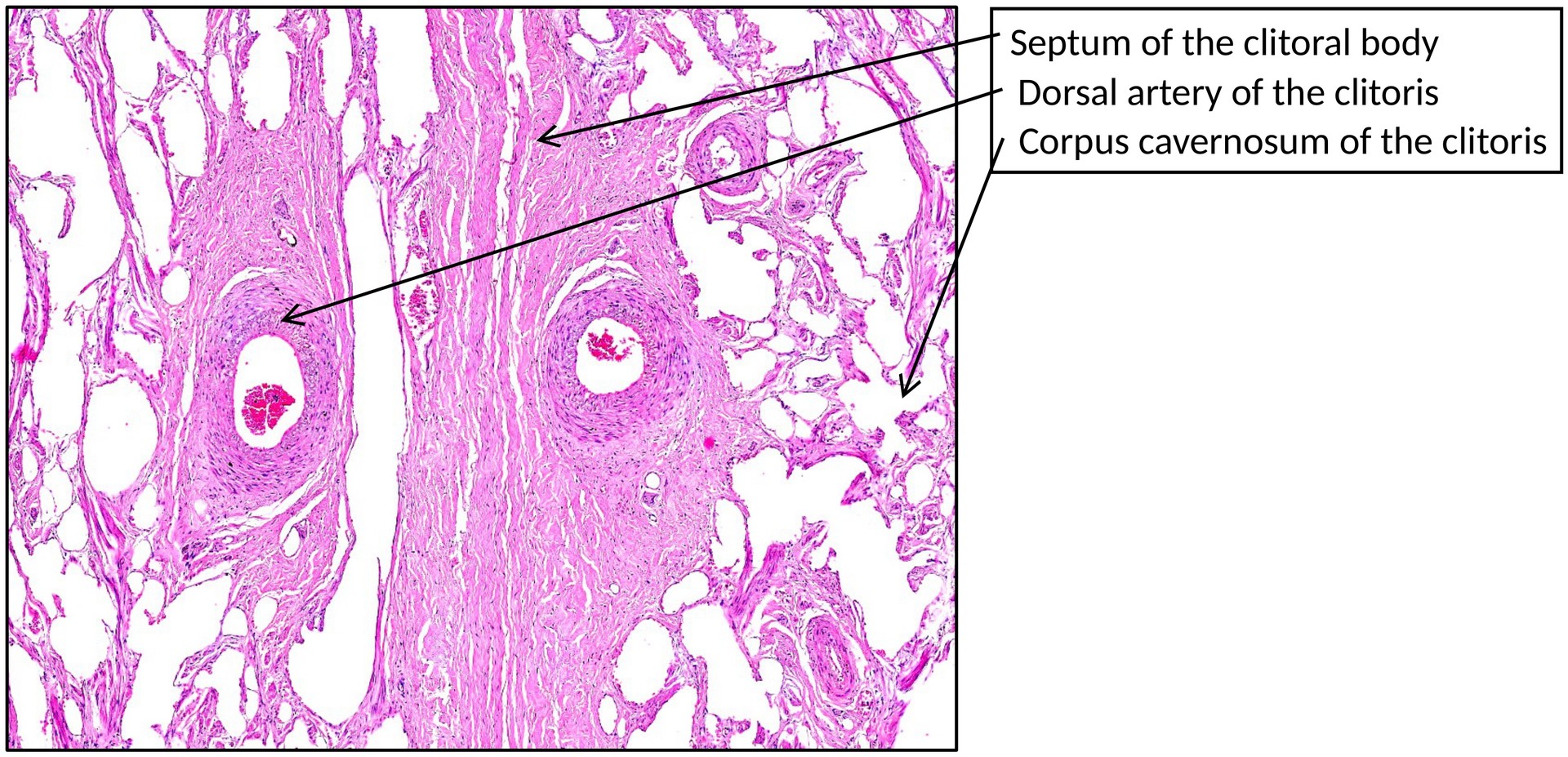
In this specimen — a cross-section through the descending part of the clitoral body — the paired cavernous bodies are evident, separated by a fibromuscular septum.
Near the septum, one can identify the deep arteries of the clitoris, which supply the erectile tissue and are key in mediating vascular filling during sexual arousal.
In addition, sections of the following structures may be observed:
-
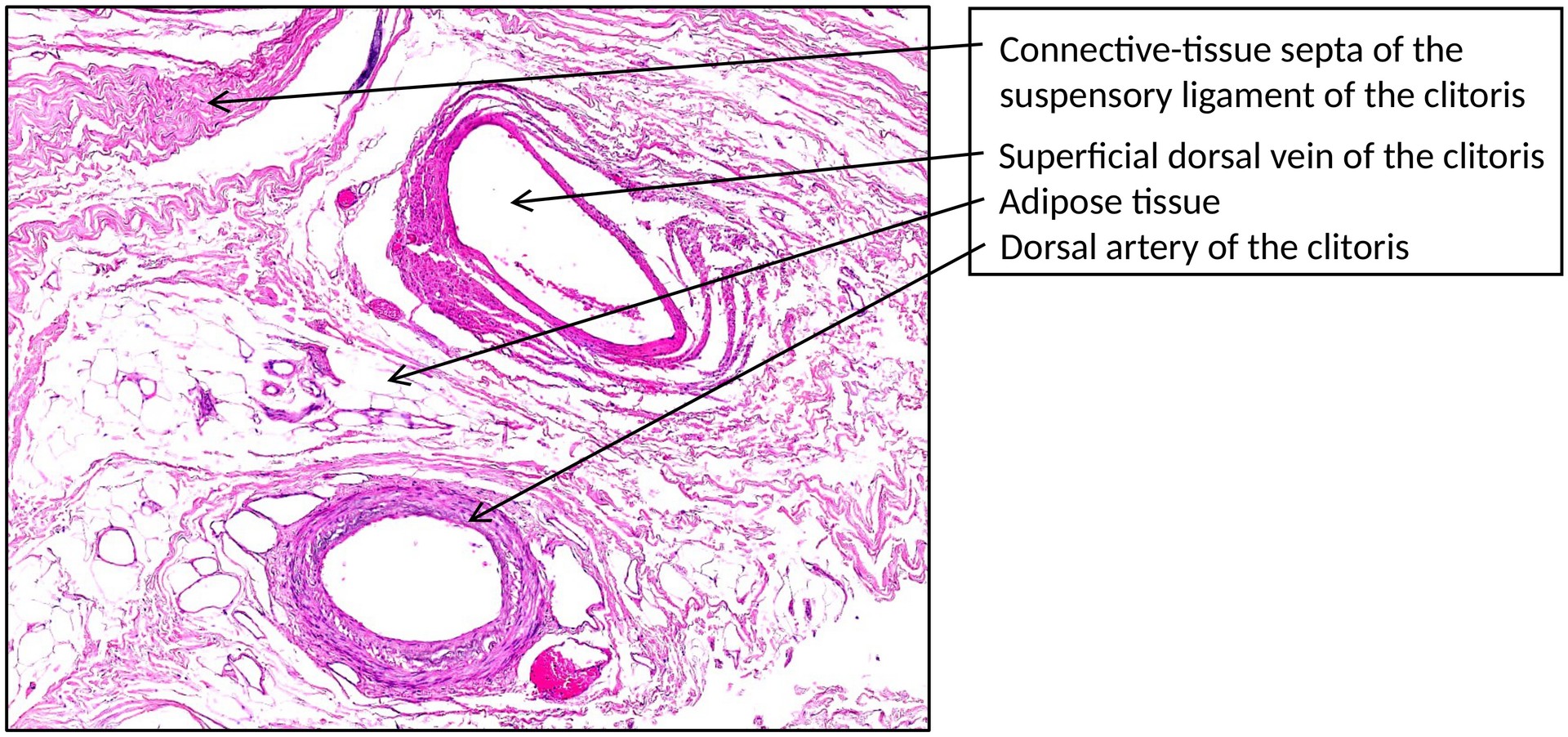
Dorsal arteries of the clitoris,
-
Superficial dorsal veins, and
-
Dorsal nerves of the clitoris (containing myelinated sensory fibres).
Externally, the entire organ is surrounded by the tunica albuginea, followed by subcutaneous connective tissue.
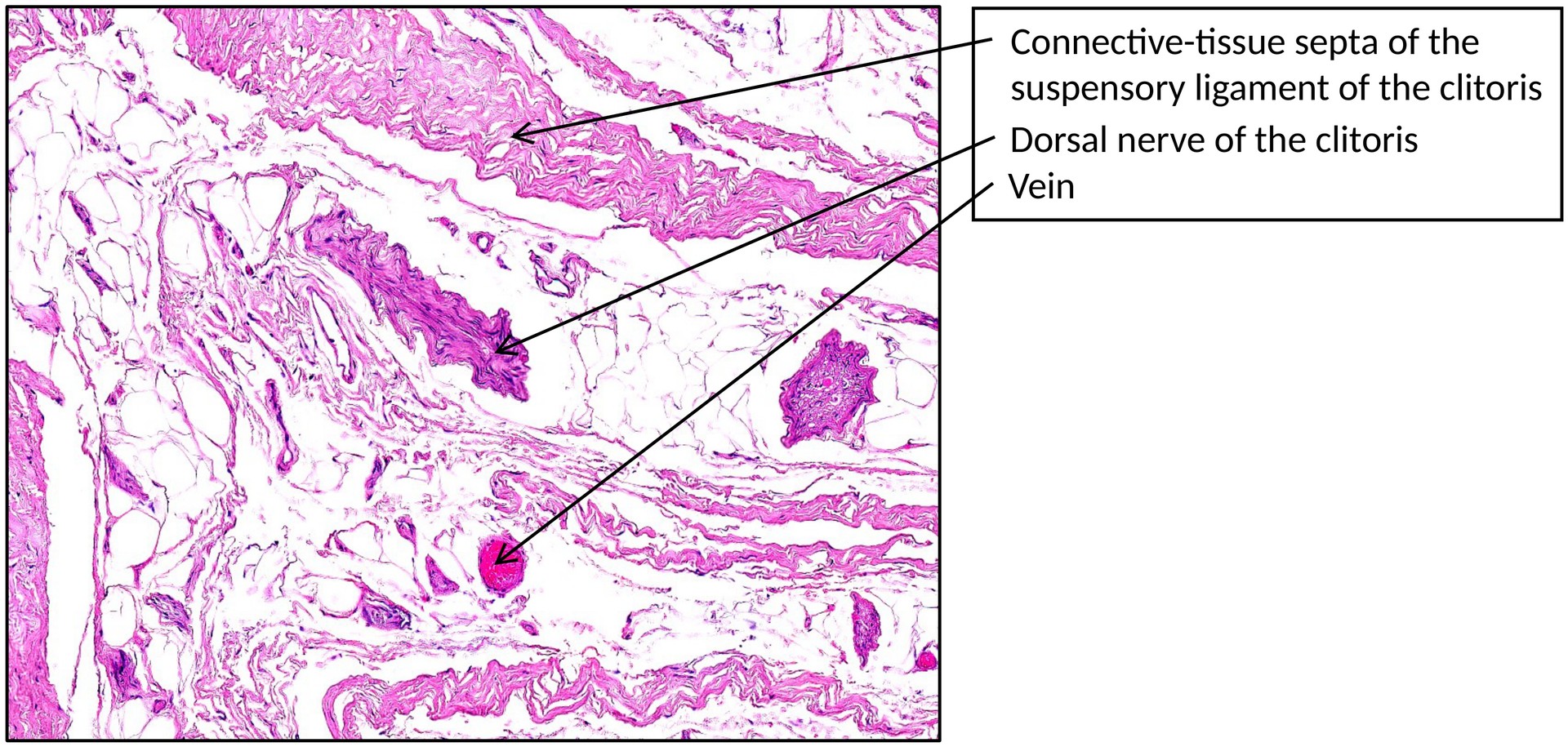
TASKS:
• Obtain an overview of the general architecture of the clitoris.
• Identify the cavernous tissue and its trabecular structure.
• Observe the tunica albuginea surrounding each corpus cavernosum.
• Locate the fibromuscular septum separating the two cavernous bodies.
• Identify the deep arteries of the clitoris within the cavernous bodies.
• Locate the dorsal arteries, veins, and nerves of the clitoris.
License
University of Basel