
SURVIVING IN AN AMBIGUOUS WORLD
2.6
When Evolution Favors Precision – A Thought Experiment
When survival depends on avoiding danger, perception may favor caution over accuracy. But what happens when the same stimulus can require different adaptive responses? In such cases, increasing behavioral flexibility may place new evolutionary pressures on perceptual precision, raising deeper questions about what “accuracy” really means.
Evolution favors perception that is adaptive, not necessarily accurate. When the cost of failing to detect a real threat exceeds the cost of falsely detecting a threat when none exists, selection pressures favor a cautious bias. Perception is then shifted toward the safer interpretation, even if this reduces perceptual precision.
Consider an ape encountering an elongated shape on the forest floor. Some such shapes are venomous snakes; others are harmless sticks. Given that the cost of mistaking a venomous snake for a stick is high, a cautious strategy is adaptive.
In such a case, fleeing whenever a stimulus resembles a snake may increase overall survival, even if many of those stimuli are in fact harmless. Over time, such a bias can become an evolutionarily stable strategy that is maintained across generations. The system becomes biased toward false alarms – interpreting ambiguous signals as threats.
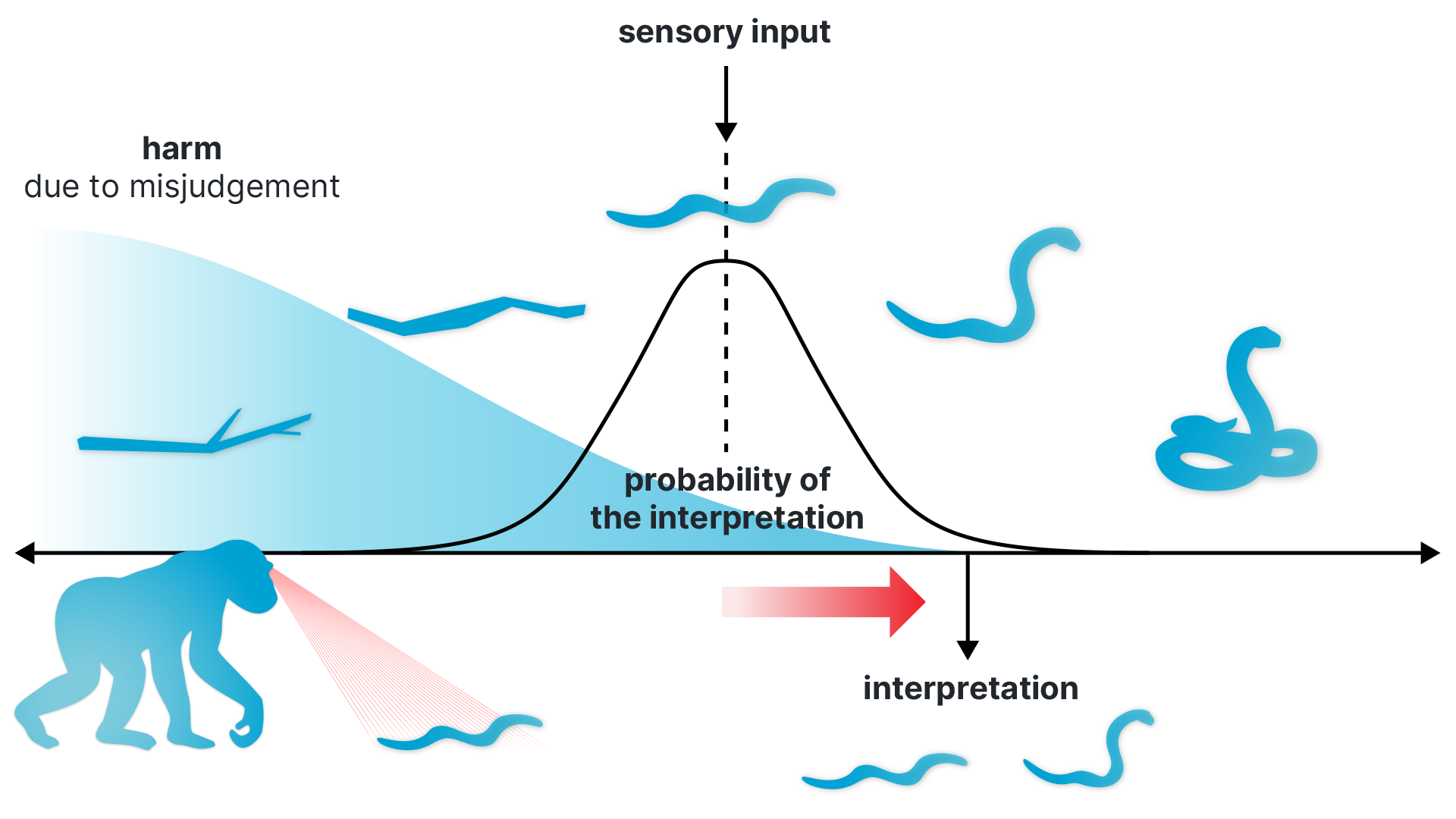
Adaptive bias under asymmetric error costs: This diagram represents a simplified decision problem: The horizontal axis depicts a range of possible stimuli, from clearly harmless to clearly threatening. Many real-world stimuli fall somewhere in between and are therefore ambiguous. The bell curve indicates how frequently different stimuli occur in the environment. Some are clearly sticks, some clearly snakes, and many lie in a grey zone of similarity. To respond, the organism must set a decision boundary: at what point does a stimulus count as a threat? When the cost of failing to detect a real snake is high, this boundary shifts toward caution. More ambiguous stimuli are then classified as dangerous. This shift increases the number of false alarms. However, it reduces the probability of a costly false negative. Under asymmetric error costs, such a bias can improve overall fitness.
The above scenario assumes a simple choice between two alternatives. But what happens when a stimulus can lead to several different adaptive responses?
Consider a more complex ecological situation. Some elongated shapes on the forest floor are venomous snakes. Others are harmless sticks. Still others may be nutrient-rich roots that provide a survival benefit. The stimulus is no longer associated with only one survival-relevant behavior. It can be interpreted as signaling danger, irrelevance, or opportunity. In the earlier example, the adaptive choice was largely unidirectional: when in doubt, flee. Here, in a more complex and also more realistic scenario, this strategy is no longer optimal. Avoiding every ambiguous shape would prevent the organism from exploiting valuable resources.
This shift changes the structure of the decision problem. The stimulus is no longer unipolar in valence, associated with a single adaptive response such as avoidance. Instead, it becomes multipolar, capable of signaling danger, irrelevance, or opportunity. The stimulus now has multiple potential payoffs. Correct discrimination between these possibilities becomes more important than merely avoiding the worst outcome.
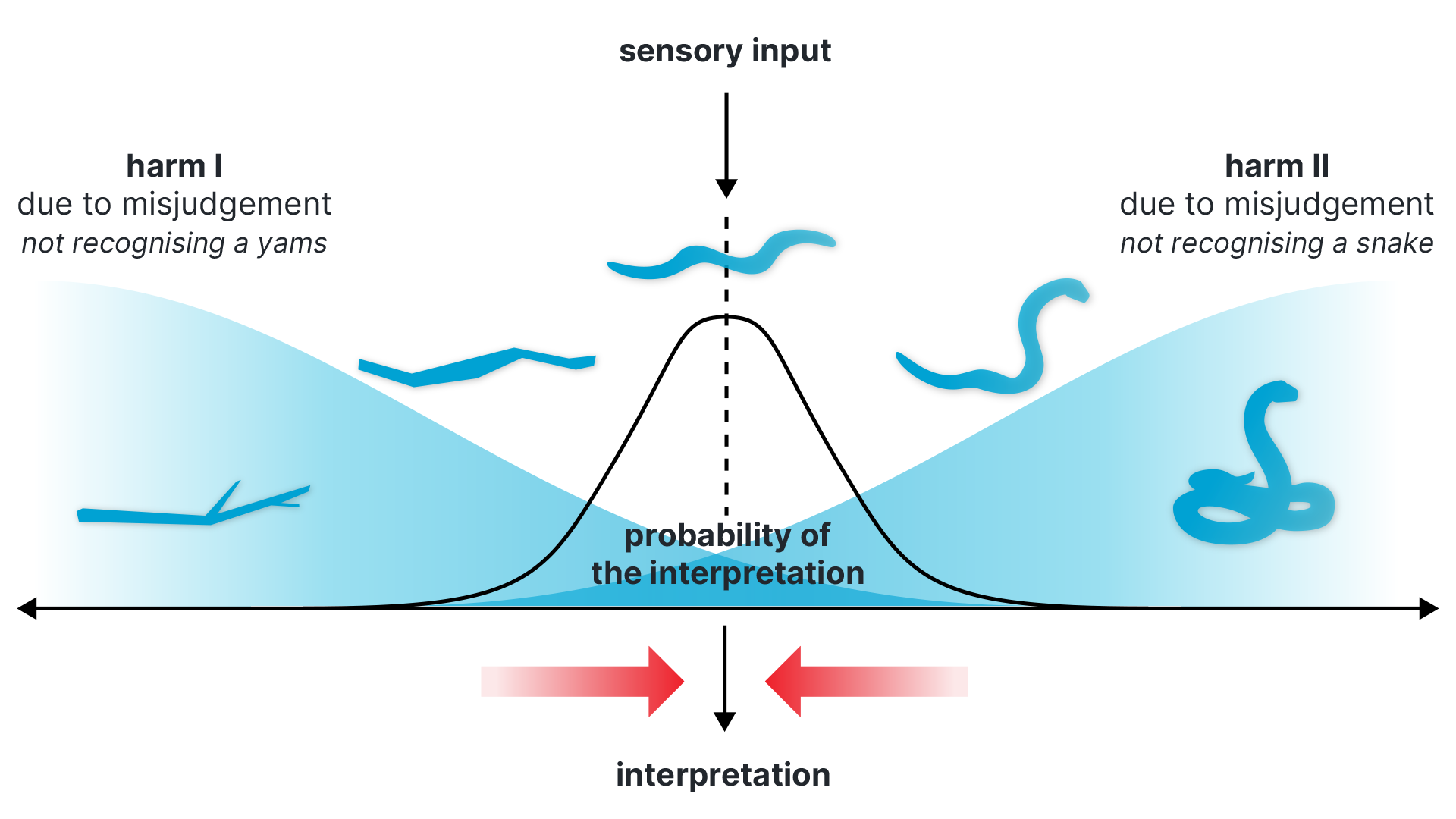
Selective pressure for perceptual discrimination under multiple response options: When a stimulus is linked to several distinct outcomes – danger, irrelevance, and opportunity – the structure of the decision problem changes. The organism can no longer rely on a single cautious rule. Different interpretations now lead to different adaptive behaviors. In such cases, fitness payoffs depend more strongly on distinguishing between similar stimuli. Mistaking a nutritious root for a snake results in a lost opportunity. Mistaking a snake for a root results in danger. The costs are distributed across multiple dimensions. As the range of possible responses expands, selection pressures favor finer perceptual discrimination. The perceptual system is pushed to resolve subtle differences more reliably, because successful action now depends on doing so. In this sense, increasing behavioral flexibility can increase the adaptive value of perceptual precision.
To optimize fitness in such a setting, perceptual systems are selected to discriminate more finely between relevant stimuli. As the number of adaptive response options increases, fitness payoffs depend more strongly on correctly identifying subtle differences between them.
This suggests a broader evolutionary principle:
Increasing behavioral flexibility exerts selective pressure on the refinement of perceptual discrimination.
In complex environments, organisms that can resolve subtle differences gain an advantage. More precise perception – whether through sharper sensory systems or more differentiated cognitive processing – can therefore become adaptive.
But this raises a deeper question: Is precision converging towards truth?
Accuracy is always measured relative to some standard. As behavioral flexibility increases, perceptual systems may approximate environmental structure more closely. Yet the benchmark remains functional: discrimination evolves in relation to action and payoff.
So: Does increasing perceptual precision imply convergence toward objective reality?
Or does it simply reflect increasingly fine-grained adaptation to survival-relevant structure?
The relationship between adaptation and accuracy remains open to interpretation. Perceptual systems evolve under selective pressures tied to survival and action. Yet increasing precision raises the possibility that cognition may track environmental structure more closely – at least in domains where fine discrimination improves fitness.
Whether this amounts to veridical perception depends on how we define reality and truth. If accuracy is measured functionally, then perception need only be reliable enough for action. If it is measured against a mind-independent structure, the question becomes more demanding.
The tension between these perspectives runs through the broader debate about how closely cognition can approach the world as it is.
Authors: Fabian Mueller & William Palmer
References
Bischof, N. (2016). Psychologie – Ein Grundkurs für Anspruchsvolle (Rev. ed.). Springer. (Chapter 13.1: “Die Evolution der Veridikalität,” pp. 127–131)