
DIMENSIONS OF REALITY
1.7
Mapping Perspectives on Reality to Epistemological Positions
In this summary step, we revisit how the different perspectives on reality relate to some of the most influential epistemological perspectives in philosophy and psychology.
Reality can be understood through four key meanings, each aligning with a distinct epistemological perspective.
| SENSE OF REALITY | DEFINITION | DISTINCTION | EPISTEMOLOGICAL POSITION | EXAMPLE |
|---|---|---|---|---|
| Reality as objective | Reality is external, physical, and independent of perception. | Objective (real) vs. Subjective (unreal) | Physicalism, Behaviorism | An object exists whether someone perceives it or not. |
| Reality as phenomenal | Reality is what is directly experienced; beyond subjective perception, nothing can be known. | Phenomenal (real) vs. Transcendent (unreal) | Idealism, Constructivism | „If I close my eyes, the world ceases to exist for me.“ |
| Reality as perceivable | Reality is what can be encountered through perception, distinguishing external reality from imagination. | Perceivable (real) vs. Imaginal (unreal) | Naïve Realism, Phenomenology | Hallucinations feel real to the individual but cannot be externally verified. |
| Reality as credible | Reality is what we determine to be true through reasoning, knowledge, and critical evaluation. | Credible (real) vs. Apparent (unreal) | Critical Realism, Evolutionary Epistemology | Perceptual illusions show that perception does not always reflect reality accurately. |
In this chapter, we learned that we can approach reality from two fundamental perspectives:
- The External Perspective: Reality is objective, independent, and measurable (physicalist view).
- The Internal Perspective: Reality is subjective, experiential, and immediate (idealistic view).
A strict reliance on the external perspective leads to physicalism, a worldview where only the material is considered real. In psychology, this position was reflected in behaviorism, which focused solely on observable behavior. Conversely, a strict focus on the internal perspective leads to idealism, a philosophical stance most notably articulated in Kantianism. Today, this position is reflected in constructivism, which emphasizes the subjective construction of reality. However, by integrating both perspectives, we arrive at realism, which can take at least two distinct forms:
- Naive Realism: Assumes that perception reflects reality as it is. This view is prominent in phenomenological philosophy, which prioritizes direct lived experience.
- Critical Realism: Acknowledges the interplay between perception and objective reality, shaped by cognitive constraints and evolutionary adaptations.
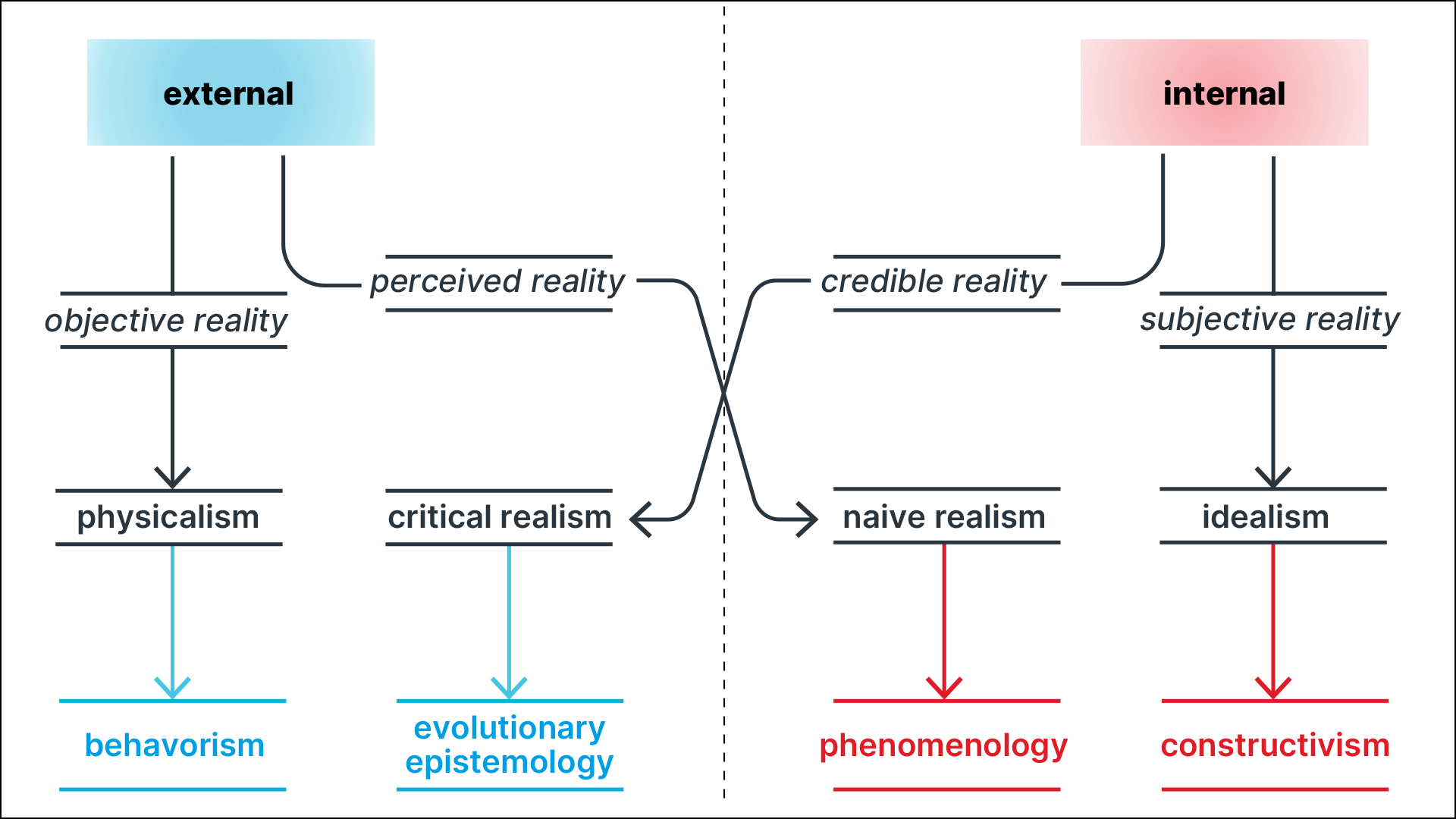
Moving forward, we adopt critical realism as our guiding epistemological stance. While we acknowledge that an objective reality exists independent of human perception, we also recognize that our access to it is shaped by biological and developmental factors. This perspective provides a balanced epistemological lens through which we explore how humans developed their understanding of the world. Furthermore, in line with evolutionary epistemology, we will draw from biology to learn how our cognition – ultimately our model of the world – has evolved throughout the course of our developmental history.
With this foundation, we now turn to the next major epistemological question: How true is what we can say about reality? In the next chapter, we will explore how evolutionary constraints have shaped cognition.
TIP:
Whenever you encounter discussions on reality, perception, or consciousness, the following questions are crucial:
1) Which perspective is being used – internal or external?
2) What assumptions are being made about what is real?
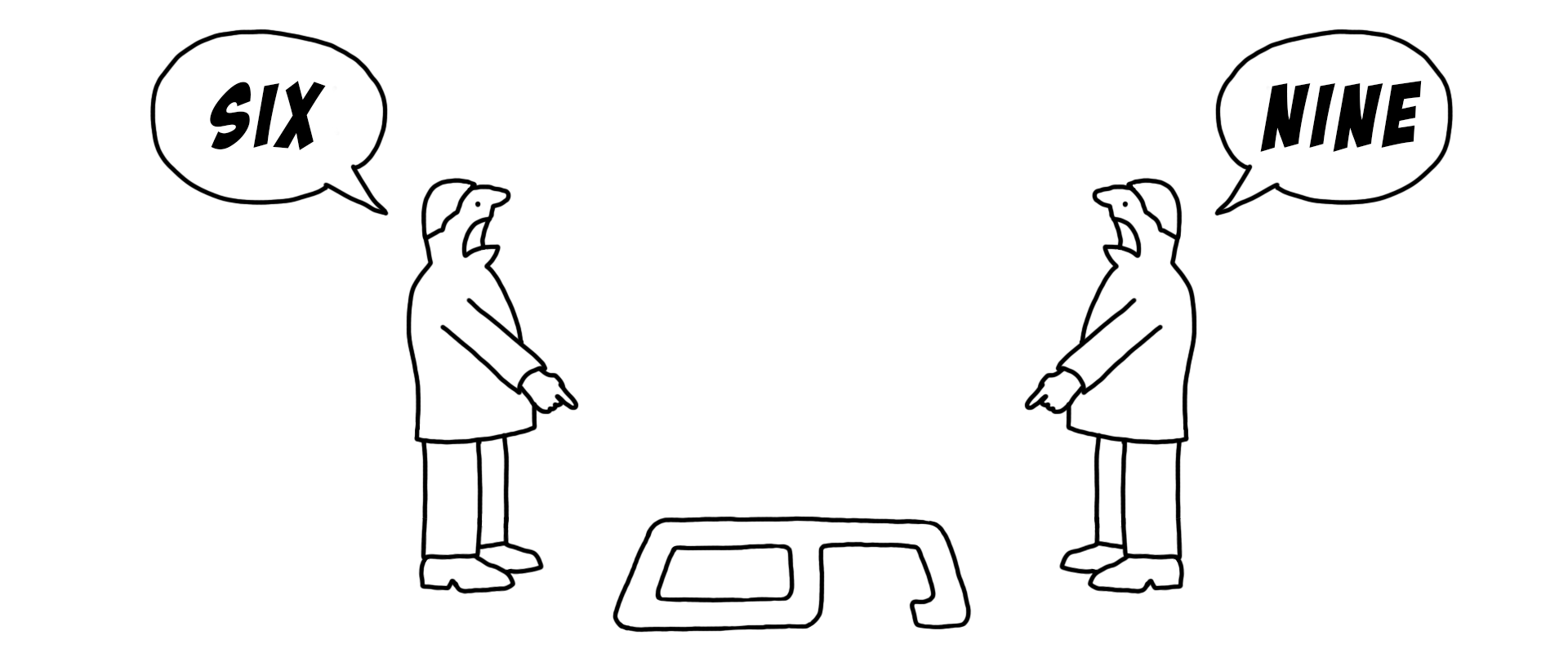
Often enough, when scientists and philosophers engage in disputes, either perspective holds validity. The only shared false belief is the assumption that they are discussing the same idea (often referred to as the jingle fallacy).
Author: Fabian Müller