
DIMENSIONS OF REALITY
1.6
Reality – the Credible
How real are perceptual illusions? Are they glitches in the Matrix, or do they reveal adaptive features of our cognitive system?
So far, we’ve established that we tend to regard what we perceive through our senses as real. However, there are countless instances where perception misleads us. Our perception is not always credible. Consider the following example:
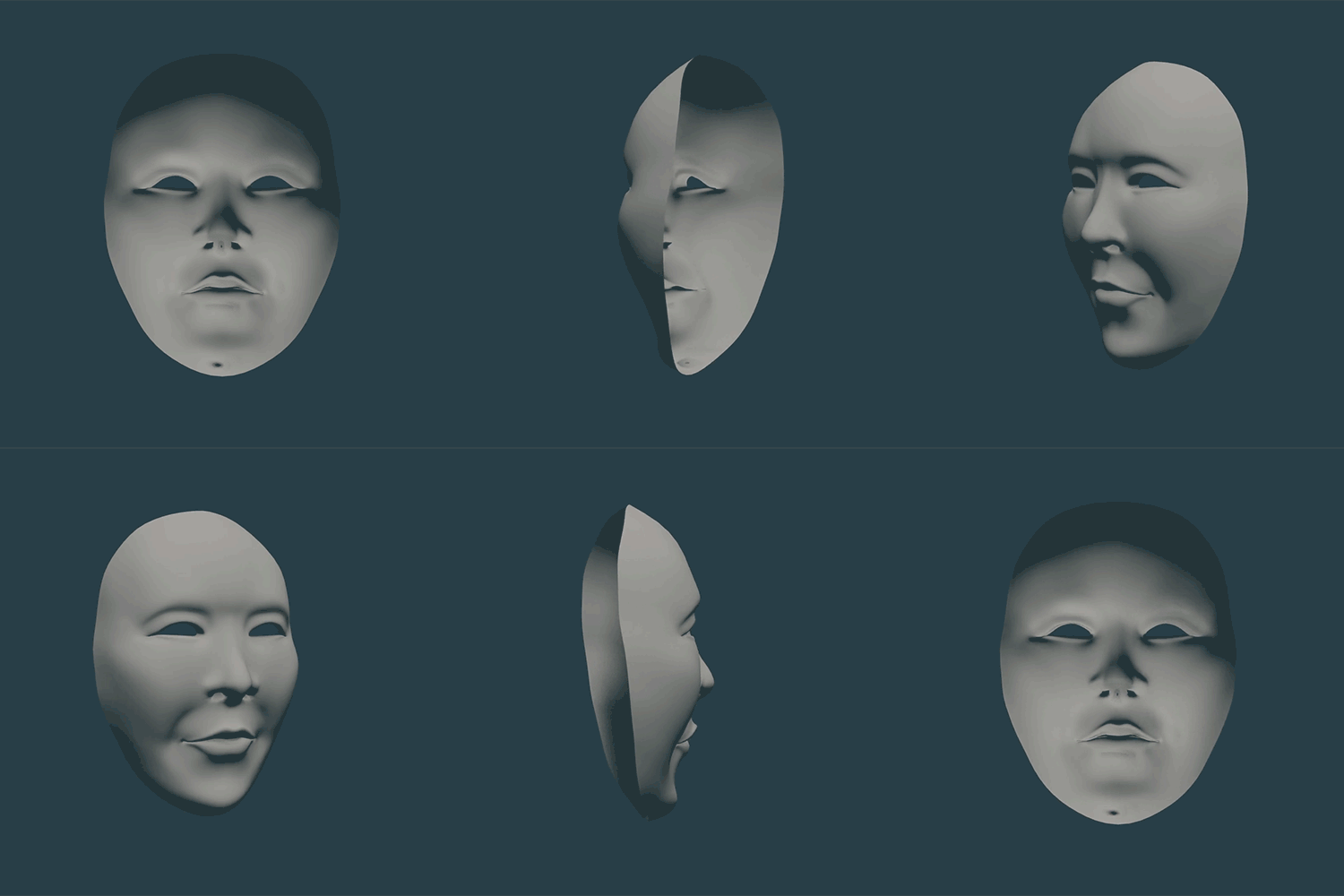
Hollow Mask Illusion
You’re looking at a rotating mask with a protruding, convex outer surface and a hollow, concave inner surface. As the mask rotates, the hollow side should appear sunken in. But When you see this Hollow Mask Illusion for the first time, your brain automatically interprets both halves of the mask as a normal, outward-facing face, even though the inside is actually hollow and curving inward. This happens because our brains are so accustomed to seeing faces that they ‘correct’ what we see to match that expectation.
Illusions like this demonstrate that (1) perception does not always reflect the outside world as it physically exists, and (2) perception is not a passive recording of reality, but an active interpretation, shaped by prior experiences and expectations.
In such cases, our perception tells us what is apparent, while our knowledge tells us what is credible. This tension invites us to critically assess how much we can trust our intuitive perceptual experience.
Thus, we can distinguish yet another sense of reality: credible reality versus mere appearance. In this case, it is not the immediate perception of the rotating mask that we consider real, but our understanding of its physical structure. The apparent reality itself, though vivid and convincing, constitutes a misinterpretation of sensory input – hence, we recognize it as an illusion.
Fourth Sense of Reality: The Credible
| real4 | unreal4 |
|---|---|
| credible | apparent |
This ability to critically reflect on our perceptual experiences marks the shift from assuming that perception directly reflects reality to recognizing it as an interpretive process shaped by cognitive and developmental constraints. Within the framework used in this course, this shift distinguishes naïve realism—the assumption that the world is as we perceive it—from critical realism, which acknowledges both an observer-independent world and the limitations of human perception.
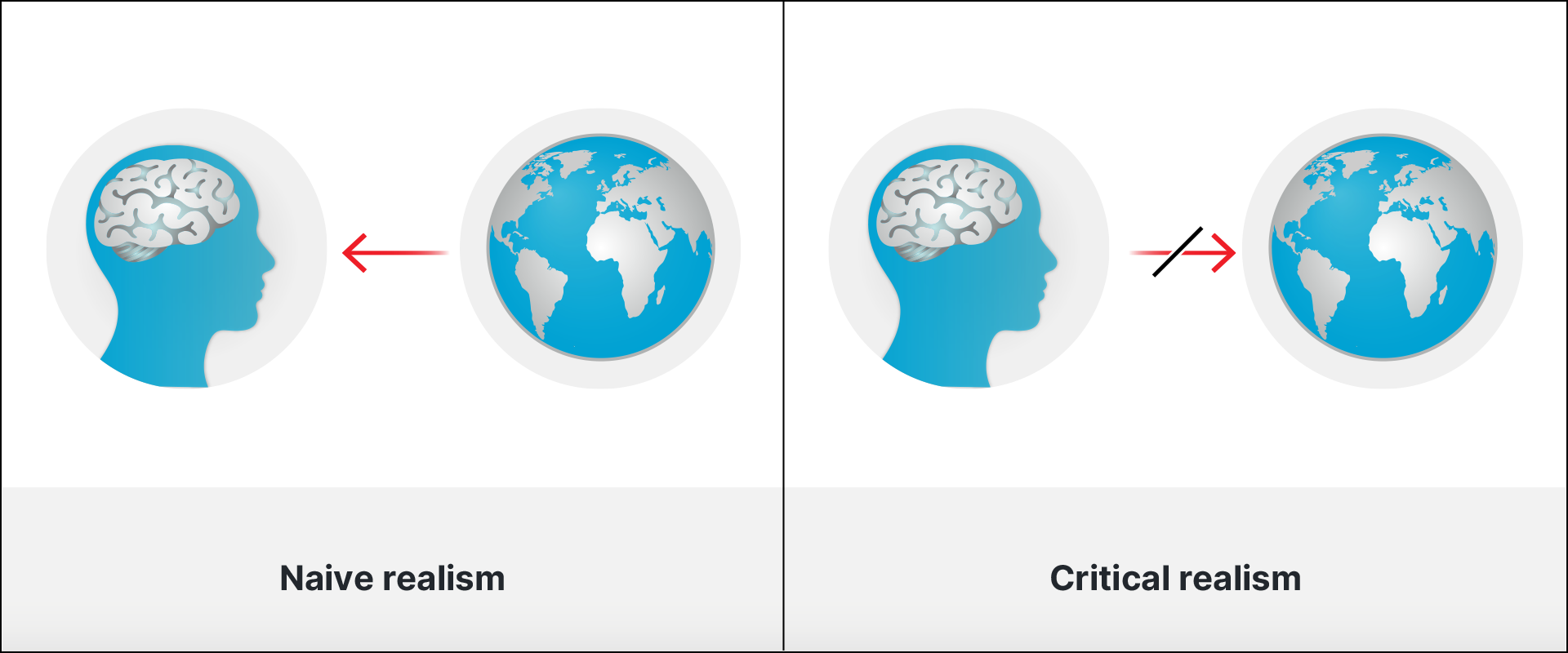
Naive and critical realism
Critical realism provides a balanced epistemological framework, acknowledging both an objective world and the cognitive constraints that shape our perception of it.. But this alone does not explain how our perceptual and cognitive systems came to be. To answer why we perceive reality the way we do, we must look at how perception and cognition have evolved over our developmental history – in other words, we must turn to evolution.
The epistemological stance that frames cognition as a product of biological evolution is known as evolutionary epistemology. This perspective asserts that the way we perceive and interpret the world – our cognitive architecture – has been and is shaped by our developmental history.
A foundational contribution to evolutionary epistemology came from Konrad Lorenz, who, in his 1941 paper Kants Lehre vom Apriorischen im Lichte gegenwärtiger Biologie (Kant’s Doctrine of the A Priori in Light of Modern Biology), laid the groundwork for an epistemology rooted in biology. Inspired by Kant, Lorenz argued that the cognitive structures we use to organize our experience of the world are evolved adaptations shaped by natural selection.
Before him, Kant understood a priori structures—such as space, time, and causality—as conditions that make experience possible, rather than as products of experience. Lorenz, however, argued that these categories are not inherent “truths,” but instead are products of our evolutionary history (phylogenetic experience). They have developed over time through our interactions with the external world. In other words, our cognitive structures exist because they have helped organisms survive, not because they are necessarily “true” in an absolute sense.
This brings us to an important evolutionary argument: if our perception and reasoning were completely detached from external reality, they could not reliably guide actions that support survival and reproduction. The physical world would “push back” against false constructions—just as an animal misjudging a jump from one branch to another could quickly face fatal consequences.
Authors: Fabian Mueller & William Palmer