
BLUEPRINTS OF THE MIND
4.3
Representing World Structure
How does perception transform raw sensory signals into things we can actually think about? In this step, we unpack the concept of “mental representations”, and why getting this right is essential for understanding the mind.
The term “representation” has long been debated across psychology, neuroscience, and cognitive science. So what exactly do we mean by it?
Many cognitive scientists describe mental representations as systems of symbols that map aspects of the world in structured, useful ways. This matters because cognitive science must explain not only how neurons fire, but what their activity stands for. Without a precise notion, we cannot determine how neural patterns encode information or how the brain uses that information to generalize, predict, and plan. Representations form the bridge between neural activity and cognition. So what makes an effective representation in our context?
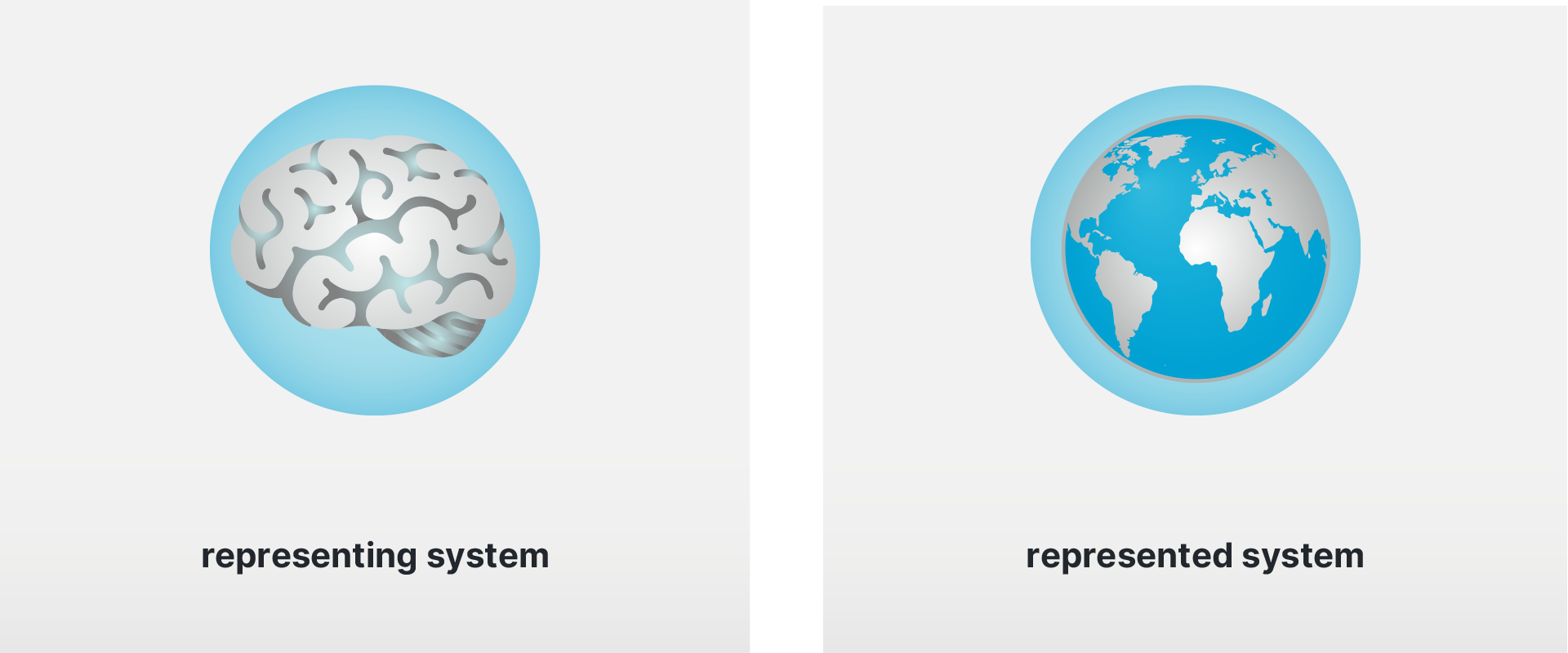
Representing System – Represented System
A representation connects two systems: symbols in the representing system (the brain) and things in the represented system (the world). For a representation to be effective, it must meet three conditions:
Causality
The connection (mapping) between entities in the external world (the represented system) and their corresponding symbols in the brain (the representing system) must be grounded in a causal relationship.
Structure-Preserving
The mapping is structure-preserving, meaning that relationships or changes in the external world (the represented system) are mirrored by equivalent relationships or changes in their corresponding symbols in the brain (the representing system). Such mappings, which maintain the structure of the original system, are referred to as homomorphisms.
Efficacious
Symbolic operations within the brain (the representing system) must effectively guide behavior. This means that the brain’s symbols and their functions should result in appropriate actions in response to the external world (the represented system). Simply put, representations must help the brain plan and interact effectively with the world.
Taken together, these conditions amount to what Randy Gallistel, an American cognitive scientist, calls a “functioning homomorphism”, a structure-preserving mapping from the world to the brain that is established causally and used to guide behavior. This means that the brain must not only preserve the structure of the external world through its symbols but also use those symbols to drive meaningful interaction.
A Simple Example of a Representation
Let’s make this abstract concept more tangible with a simple example. Imagine a parent tracking the height of their growing child by making marks on a wall. Here’s how it works:
- The Represented System: The height of the child.
- The Representing System: The graphite marks on the wall.
- The Mapping: The correspondence between the child’s height and the vertical position of each mark,, established by standing the child against the wall, placing a flat object like a book on their head, and making a mark where the book touches the wall.
This example illustrates the three critical features of representation:
- Causal: The child’s height directly determines where the mark is made on the wall.
- Structure-Preserving: The relative positions of the marks on the wall mirror the relative heights of the child over time. Higher marks correspond to taller measurements, preserving the order and magnitude.
- Efficacious: These marks are useful. For example, a parent might use them to decide when to buy a larger size of clothing for their child.
Note that the mark on the wall isn’t the height itself. Erasing the mark wouldn’t make the child shorter, and making a new mark lower on the wall wouldn’t shrink the child. The mark is a symbol, a representation of the child’s height as measured at a specific moment in time.
This simple analogy helps clarify how representations may work in the brain. Just as the mark on the wall stands in for the child’s height, symbols in the brain stand in for aspects of the world, allowing us to think about, plan for, and respond to our environment.
Creating a functioning homomorphism, where sensory inputs map to a coherent and actionable representation of the external world, is a central task of the brain. But how do we get from a stream of noisy, ambiguous sensory input to a structured internal model of the world? In the next step, we explore how the visual system extracts meaningful structure from the world – one feature at a time.
Authors: Fabian Mueller & William Palmer
References
Memory and the Computational Brain: Why Cognitive Science Will Transform Neuroscience C. R. Gallistel and Adam Philip King © 2010 C. R. Gallistel and Adam Philip King ISBN: 978-1-405-12287-0
Yildirim, I. (2023). Algorithms of the Mind, Course 2: The Three Pillars of Mental Representations & An Origins Story. Yale University.