
SURVIVING IN AN AMBIGUOUS WORLD
2.3
Better Safe than Sorry!
Error Management Theory 1
In uncertain situations, the challenge is not simply to avoid being wrong, but to avoid the mistakes with the most serious consequences.
When navigating the world, humans and other animals constantly must make decisions under conditions of uncertainty. The outcomes of these decisions are rarely fully known in advance.
If perception has been shaped to support survival rather than perfect accuracy, then successful judgment depends not only on correctly representing the world but also on managing the costs of potential errors. The central question is therefore: Which mistake is more costly?
Stick or Snake?
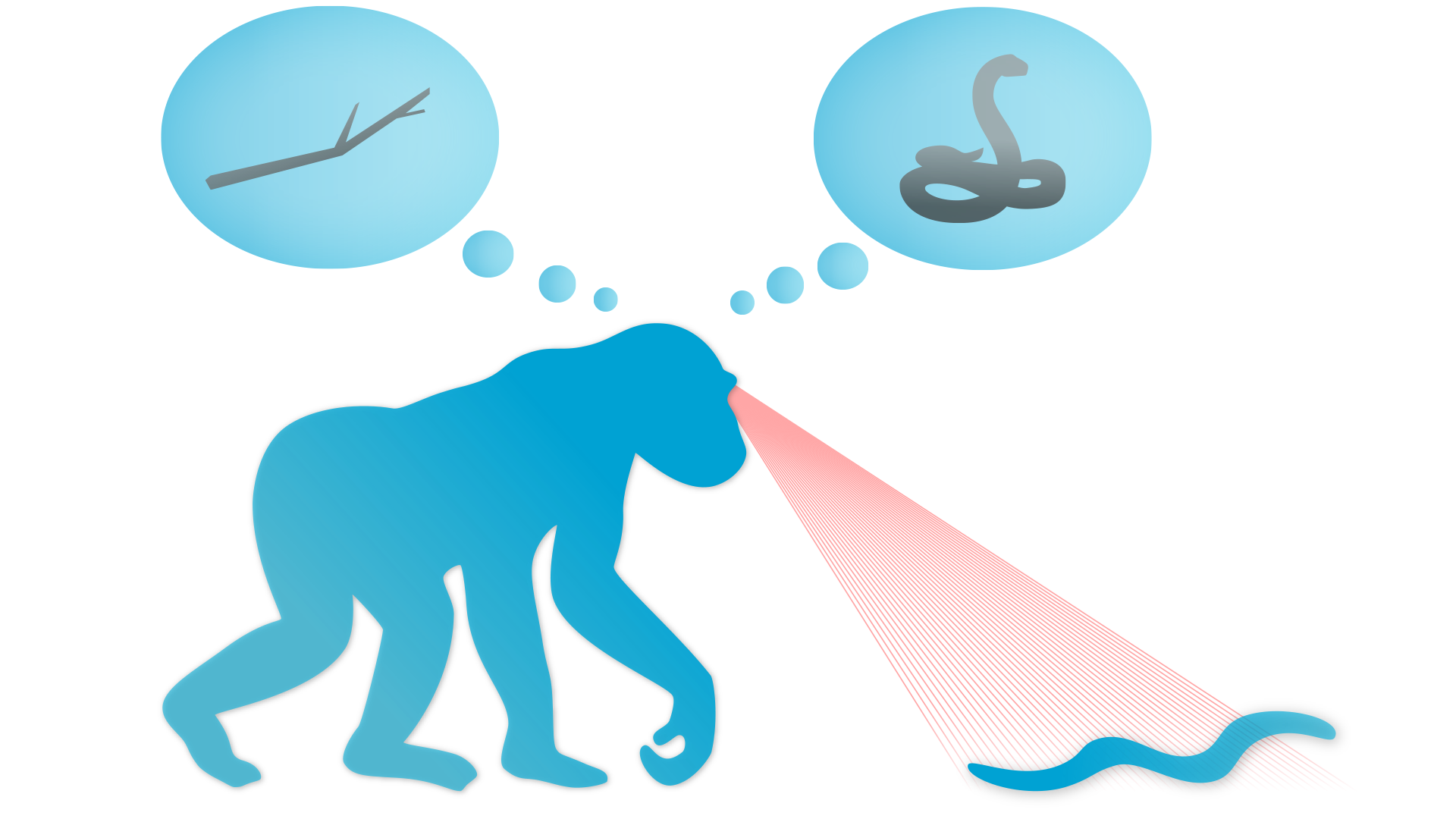
Consider a group of apes foraging in the jungle. One ape notices an elongated shape on the forest floor. Is it a stick, or a venomous snake? The animal faces a decision: remain where it is, or retreat to safety?
This classic “snake or stick” example illustrates that decisions are not only about accuracy; they are also about the consequences of being wrong. Mistaking a snake for a stick may have severe consequences. An ape that treats a real snake as harmless may not survive the error.
If, however, the ape mistakes a stick for a snake and retreats, the cost is comparatively small—perhaps a missed opportunity to find food.
This situation can be represented in a simple decision matrix. Two questions determine the outcome: What is actually present in the environment? And what does the ape believe is present?
| In fact, it is a snake | In fact, it is a stick | |
|---|---|---|
| The ape believes it is a snake | Correct | False Positive |
| The ape believes it is a stick | False Negative | Correct |
The four possible combinations of beliefs and actual state, resulting in two distinct types of error.
- False Positives: Perceiving a threat where none exists (e.g., mistaking a stick for a snake).
- False Negatives: Failing to perceive a real threat (e.g., mistaking a snake for a stick).
Mistaking a stick for a snake—a false positive—may result in wasted energy or unnecessary caution. Mistaking a snake for a stick—a false negative—can lead to injury or death. The costs of these errors are therefore asymmetrical.
Over evolutionary timescales, individuals that responded cautiously in ambiguous situations – treating even harmless objects as potential threats – would have had a higher probability of survival and reproduction. This asymmetry is captured by the expression “better safe than sorry.” The principle helps explain why cautious responses may be favored in uncertain situations.
Error Management Theory builds on this principle: when decisions must be made under uncertainty, cognition may be biased toward the less costly type of error rather than toward perfect accuracy.
Authors: Fabian Mueller & William Palmer
References
Bischof, N. (2014). Psychologie: Ein Grundkurs für Anspruchsvolle. W. Kohlhammer Verlag.
Johnson, D. D. P., Blumstein, D. T., Fowler, J. H., & Haselton, M. G. (2013). The evolution of error: Error management, cognitive constraints, and adaptive decision-making biases. Trends in Ecology & Evolution, 28(8), 474–481. https://doi.org/10.1016/j.tree.2013.05.014
Martin, J. M., Solms, M., & Sterzer, P. (2021). Useful misrepresentation: Perception as embodied proactive inference. Trends in Neurosciences, 44(8), 619–628. https://doi.org/10.1016/j.tins.2021.04.007
Haselton, M. G., & Galperin, A. (2011). Error management and the evolution of cognitive bias. Sydney Symposium of Social Psychology. University of California, Los Angeles. Retrieved from https://sydneysymposium.unsw.edu.au/2011/chapters/HaseltonSSSP2011.pdf