
THE FOUNDATIONS OF COGNITION
3.11
The Origins of Thought
How do we move from simply sharing emotions to understanding what others think? This article traces the development of social cognition—from emotional contagion to the emergence of Theory of Mind.
Self-recognition marks an important turning point in cognition. But understanding oneself is only part of the story. Social life requires something more: the ability to feel what others feel, and to know what others know.
At its most elementary level, social understanding does not begin with reflection or reasoning. It begins with resonance. Emotional states can spread automatically from one individual to another. When one infant begins to cry and others soon join, or when laughter cascades through a group without anyone knowing why, we witness this immediate transmission of affect.
This phenomenon is known as emotional contagion. It does not require insight into another’s perspective. It arises from an embodied coupling of expressions.

Emotional contagion can be observed in group behavior, where sudden arousal spreads rapidly through a flock or herd.
Image: Adobe Stock
Emotional contagion, however, is not yet empathy. In contagion, the organism simply catches an affective state. Empathy requires a further cognitive step: the ability to understand the other’s emotion as belonging to the other, not to oneself. Only when an organism can differentiate between “my state” and “your state” can emotional resonance develop into social behavior directed toward another individual.
A well-documented example comes from great apes. Chimpanzees have been observed to display behavioral expressions of genuine empathy: after conflicts, uninvolved bystanders sometimes approach distressed individuals, embrace them, groom them, or remain close in a manner that reliably reduces agitation. Such consolation is difficult to explain as mere emotional contagion. It suggests a form of sensitivity to another’s distress, paired with behavior that appears directed at alleviating it.
Empathy can be understood as a mechanism of social cognition that provides insight into another individual’s emotional state, with participation in the other’s emotion playing a decisive role.
Human-like empathy, however, requires not only an affective component (feeling with another), but also a cognitive component: perspective taking. The next major leap in social cognition is the ability to represent not only others’ emotions, but also their beliefs and intentions. This capacity is known as Theory of Mind. Children typically acquire this ability around the age of four. A classic demonstration is the Maxi paradigm, developed by the Austrian developmental psychologists Heinz Wimmer and Josef Perner (1983).
The classic Maxi paradigm (Wimmer & Perner, 1983) illustrates this developmental milestone. A child watches as “Maxi” places a key in a bright box. While Maxi is away, the key is moved to a dark box.
When asked where Maxi will look for the key, younger children – who have not yet developed a full Theory of Mind – answer “in the dark box,” where the key actually is. Children who have acquired Theory of Mind answer “in the bright box,” recognizing that Maxi holds a false belief about the object’s location.
This marks the understanding that others can hold perspectives different from one’s own – a foundational achievement in human cognition.
Comparable experiments with chimpanzees suggest that while they can track what others have seen, they do not seem to grasp how the same situation can appear differently from another individual’s point of view.
Why “Maxi”
In the original study, the third person was called “Maxi,” which is why the task became known as the “Maxi paradigm.” The hidden object was originally a piece of chocolate – but this distracted some children. A key turned out to be a more reliable choice.
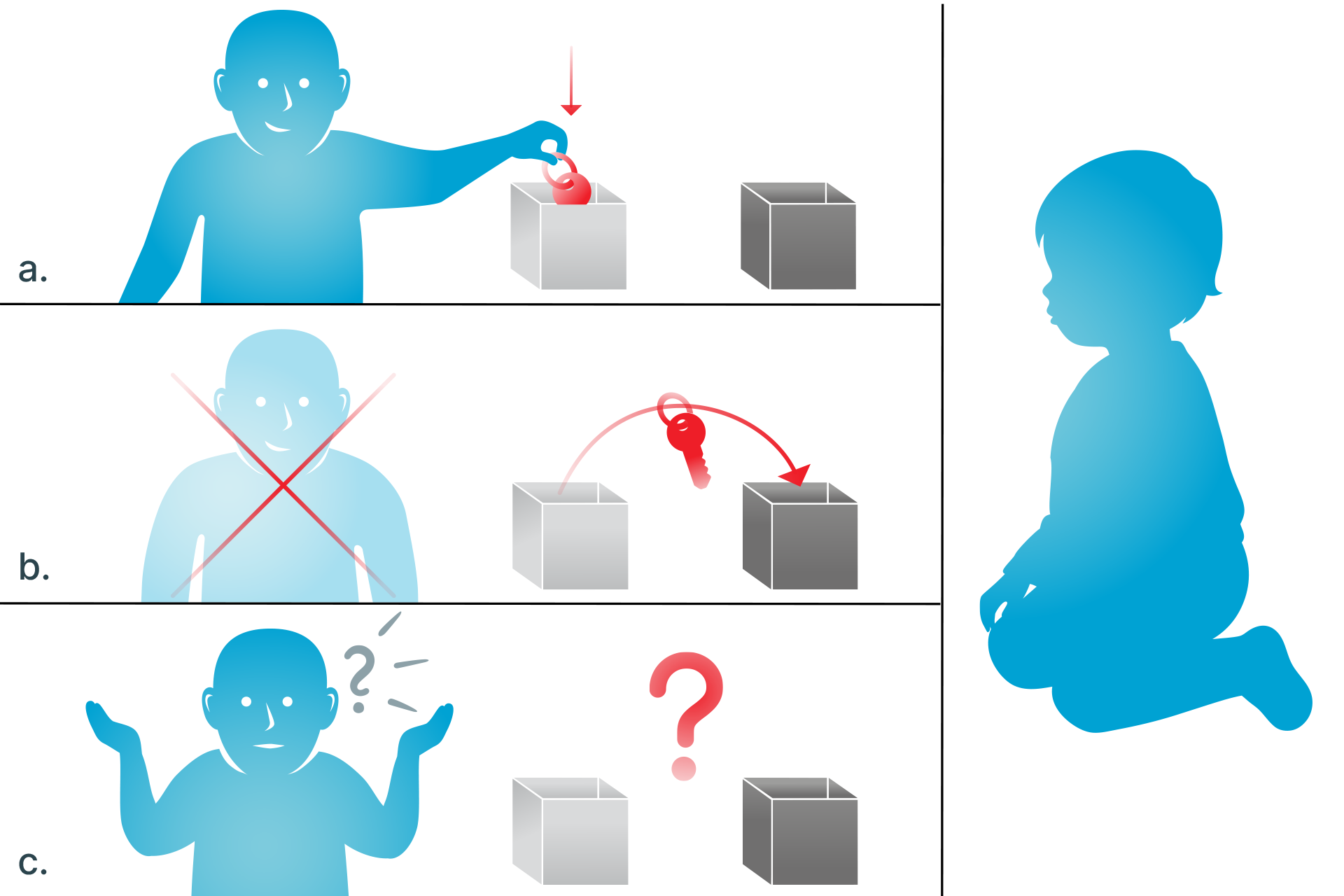
The Maxi paradigm (Wimmer & Perner, 1983).
A child observes how:
a) Maxi places a key into a bright box that lies beside a dark box.
b) While Maxi is absent, the key is moved from bright box to dark box.
c) When Maxi returns, children must decide where Maxi will look.
Correctly answering “bright box” shows an understanding of false belief.
Full-fledged Theory of Mind – especially the understanding of false beliefs – has so far been demonstrated only in humans. It typically emerges around the age of four.
However, several species show precursors of this capacity. Great apes such as chimpanzees, bonobos, and orangutans can infer what others see or know – a rudimentary form of perspective taking. Corvids, including ravens and scrub jays, show similar abilities when they re-hide food after noticing that another bird has observed their cache. Dogs also appear sensitive to human gaze and attention, though this likely reflects cue-reading rather than genuine mental-state attribution.
No non-human animal, however, has yet passed a full false-belief test. For now, this remains the defining criterion for mature Theory of Mind.
Suggested Media
Short demonstration of the “False Belief” Test: Theory of the Mind https://www.youtube.com/watch?v=8hLubgpY2_w
References
Wimmer, H., & Perner, J. (1983). Beliefs about beliefs: Representation and constraining function of wrong beliefs in young children’s understanding of deception. Cognition, 13(1), 103–128.
de Waal, F. B. M. (2008). Putting the altruism back into altruism: The evolution of empathy. Annual Review of Psychology, 59, 279–300.
Author: Fabian Müller