
THE FOUNDATIONS OF COGNITION
3.12
Human Specific Fantasies
How does language transform thought? Classic ape-language experiments suggest that symbolic representation did not evolve primarily for communication, but as a cognitive tool for linking concepts, reasoning, and solving problems.
Among the traits often considered uniquely human, language stands at the forefront. Yet in the mid-20th century, several researchers began to ask whether apes might grasp elements of it.
In the late 1940s, Keith and Catherine Hayes adopted a chimpanzee named Viki and raised her like a human child. They even gave her speech therapy, physically guiding her jaw to help her pronounce words.
After years of effort, Viki managed to articulate just three words:
- mama
- papa
- cup
The most complex was “cup”, which, as Catherine Hayes noted, did not refer to the object itself but instead meant “I want a drink.” The experiment suggested that chimpanzees possess only very limited vocal learning abilities.
In the 1960s, Allen and Beatrix Gardner pursued a different approach. They suspected that apes fail to speak not because they lack intelligence, but because their vocal anatomy limits them. Their subject, Washoe, was raised much like a human child – she wore clothes, joined family meals, and went on car rides.
Over time, Washoe learned about 350 signs. After hearing a dog bark in the distance, she spontaneously signed “listen-dog”. She had seen the sign for “dog” only in a picture book, yet she applied it to an unseen, real dog she could only hear.
This suggested that she grasped the meaning of the sign, rather than merely its repeated association with a specific object. Washoe’s behavior pointed toward a conceptual understanding of symbols.
Building on the Gardners’ work, psychologists Anne and David Premack conducted more systematic studies in the 1970s with a chimpanzee named Sarah. For them, language was primarily a matter of conceptualization. Words – or symbols – express pre-existing concepts, rather than creating them.
To test this idea, they developed a visual language system using colored plastic tokens that Sarah could arrange on a board. Each token represented a word or concept, similar to written language.1
Sarah learned to use these symbols to denote objects, colors, actions, and relations. She could even answer logical questions – for example, identifying that red is not the color of an apple when shown a banana.
The Premacks wrote: “Sarah, a young chimpanzee, has a reading and writing vocabulary of about 130 words. Her understanding goes beyond the meaning of words and includes the concepts of class and sentence structure.”
Their findings suggested that chimpanzees can grasp abstract, propositional structures, using symbols to represent not only things but also relations between them.
These experiments show that chimpanzees are capable of symbolic communication, even though they do not use such systems spontaneously in the wild. If apes can communicate symbolically, this ability must have had adaptive value long before humans appeared.
Yet in their natural environment, apes rarely rely on such symbolic systems. Their gestures suffice for vital and social needs. It therefore seems unlikely that communication alone drove the evolution of symbolic representation.
The crucial question becomes: what made these new linguistic categories useful?
Premack’s studies showed that chimpanzees can use symbols not only to represent objects such as apples or bananas, but also to denote attributes “red”, actions “give,” “run”, and relations “is a,” “is not,” “is different from”.
This ability marks a decisive step: properties, actions, and relations can themselves be treated as discrete conceptual “things”. We will call this cognitive process reification.
Reification is the cognitive process of transforming a property, action, or relation into a discrete conceptual “thing” that can be mentally manipulated. It goes beyond simple abstraction by converting transient qualities into stable mental objects.
Consider the following simple event:
Maryam places a package on the table. Because the table is slanted, the package slides off.
This simple sequence involves more than concrete things (Maryam, table, package). It also requires recognizing abstract relations (on top of, causes, falls).
Reification allows these relations and actions to be transformed into conceptual nouns – the slant, the movement, the fall. Once comprehended as “things”, they can enter new relations: the slant caused the fall; the fall was bad; the movement had a direction.
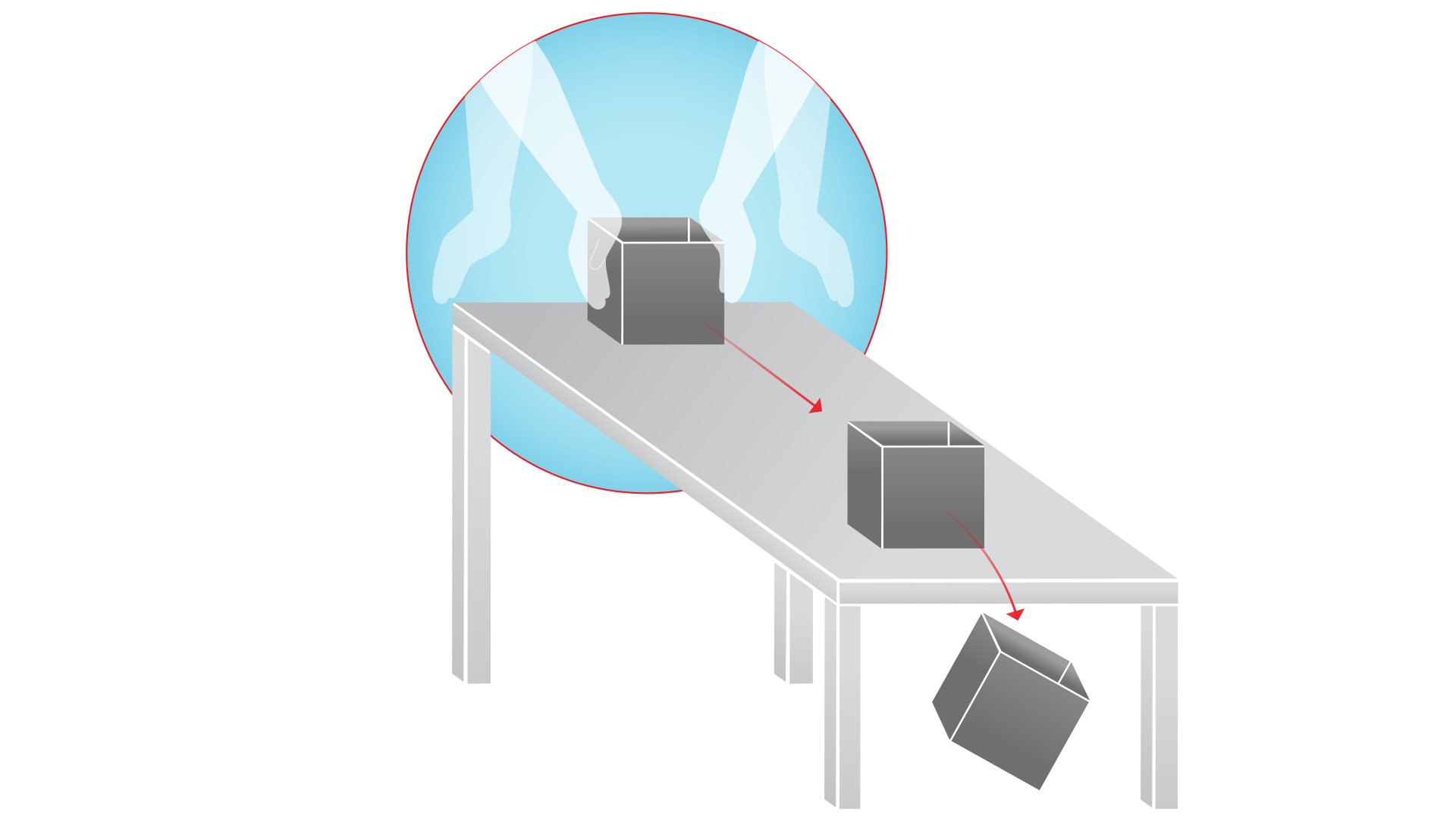
The event
A simple physical event.
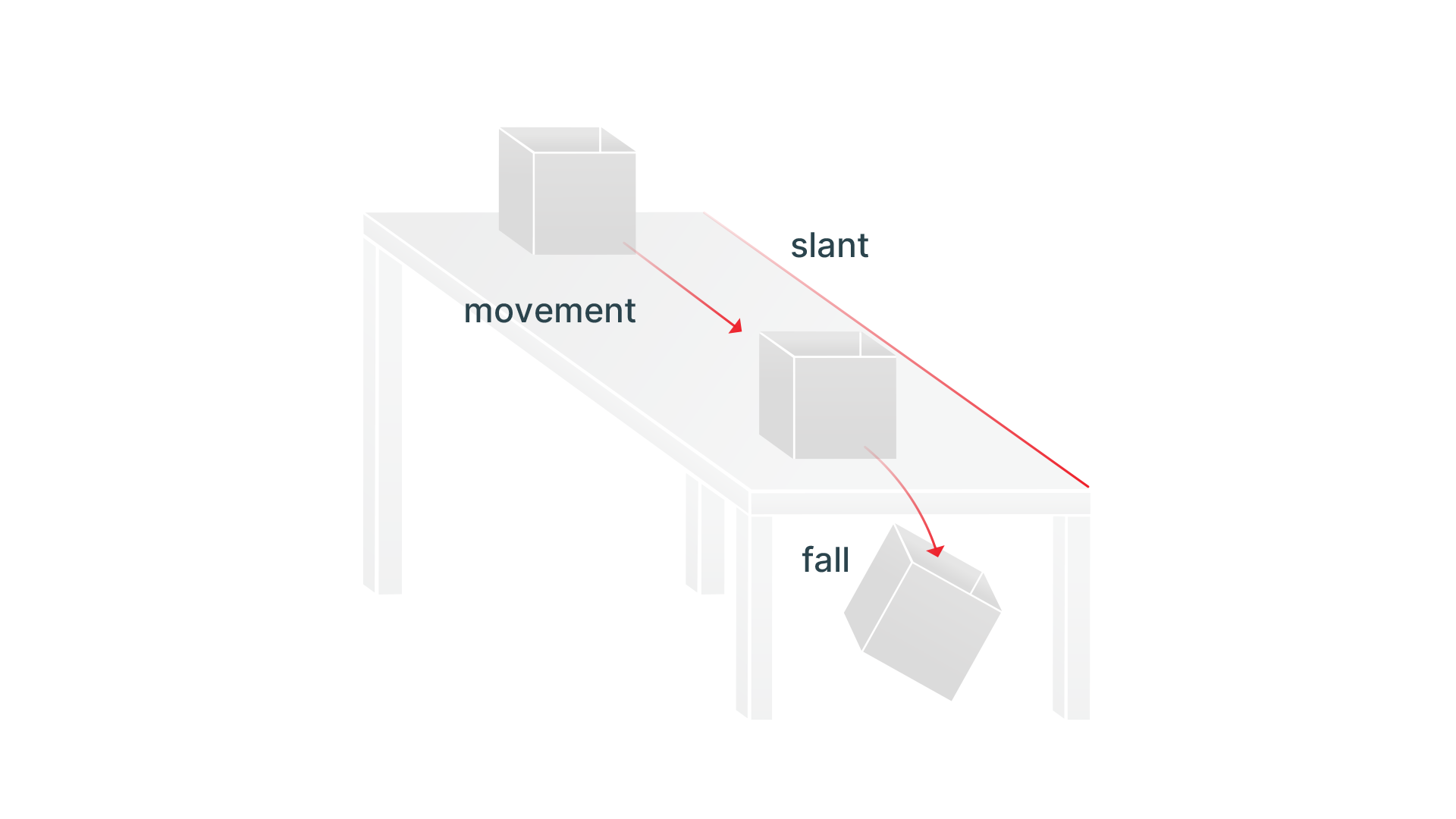
Segmentation
The mind isolates elements of the event.
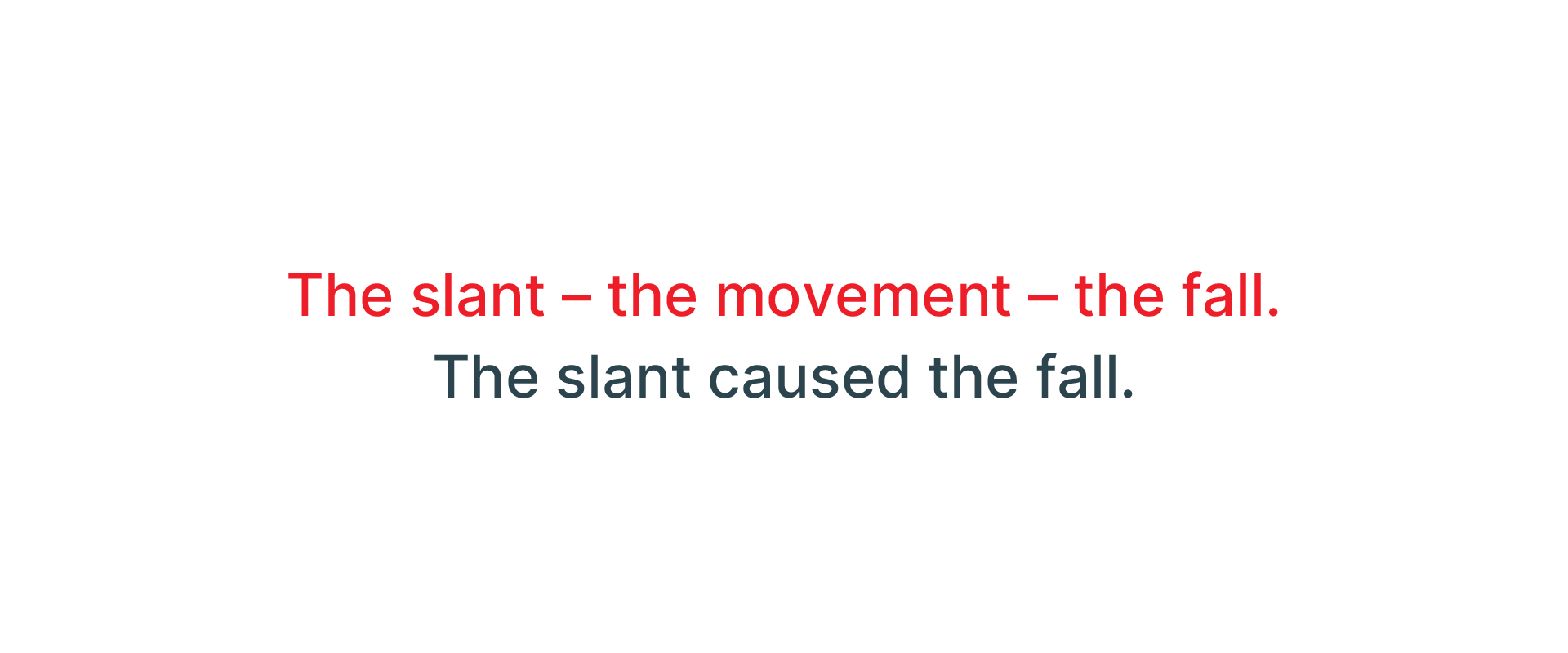
Reification
Relations and actions become conceptual objects that can enter new relations.
This linguistic universality – the capacity to turn beautiful into beauty, or fall into a fall – forms the conceptual foundation for building nested, interconnected chains of ideas. It provides the structural basis for causal thought and for what we call reasoning.
Language can therefore be understood primarily as a mechanism productive thinking: for linking concepts – a cognitive tool that emerged in the service of problem-solving and mental simulation. From this perspective, it becomes plausible that symbolic representation first evolved not primarily for communication, but to think more effectively.
Hurry-Hurry
An illustrative observation supporting this idea comes from Washoe, the chimpanzee. She was observed signing “hurry–hurry” while running, as if accompanying her own action with internal speech. She did not restrict her use of learned signs to interactions with the Gardners but also employed them spontaneously for self-guidance. Such behavior suggests that inner speech – the silent verbal accompaniment of thought – is not derived from social communication, but a natural manifestation of cognitive activity itself. It reflects the internalization of linguistic behavior as a means of structuring and directing one’s own thinking.
Thus, it is not accurate to claim that humans are the only beings capable of language. What distinguishes them is the extent to which language has become a universal medium of communication.
Author: Fabian Müller
Suggested Media
Watch Viki saying “Papa”, “Mama” and “Cup: https://www.youtube.com/watch?v=1-_LsVQb3t0
References
Hayes, K. J., & Hayes, C. (1951). The intellectual development of a home-raised chimpanzee. Proceedings of the American Philosophical Society, 95(2), 105–109.
Gardner, R. A., & Gardner, B. T. (1969). Teaching sign language to a chimpanzee. Science, 165(3894), 664–672.
Premack, D. (1971). Language in chimpanzee? Science, 172(3985), 808–822.
Premack, D., & Premack, A. J. (1972). Teaching language to an ape. Scientific American, 227(4), 92–99.
Deacon, T. W. (1997). The symbolic species: The co-evolution of language and the brain. W. W. Norton. {.citation-indented}
-
Find a scheme with the used plastic tokens in the original article (Premack, 1972, p. 3): https://ketabak.org/sites/default/files/prem ){:target=”_blank”} ↩