
DIMENSIONS OF REALITY
1.3
Reality – the Objective
Let us begin with an intuitive approach to reality: understanding it in terms of objectivity.
Picture a simple perceptual scenario. An organism encounters an object. This object is perceived as a stimulus by the sensory organs, which are then transmitted and processed by the central nervous system. Ultimately, this generates a signal for the perceiving subject, the meaning of which is experienced as a phenomenon.
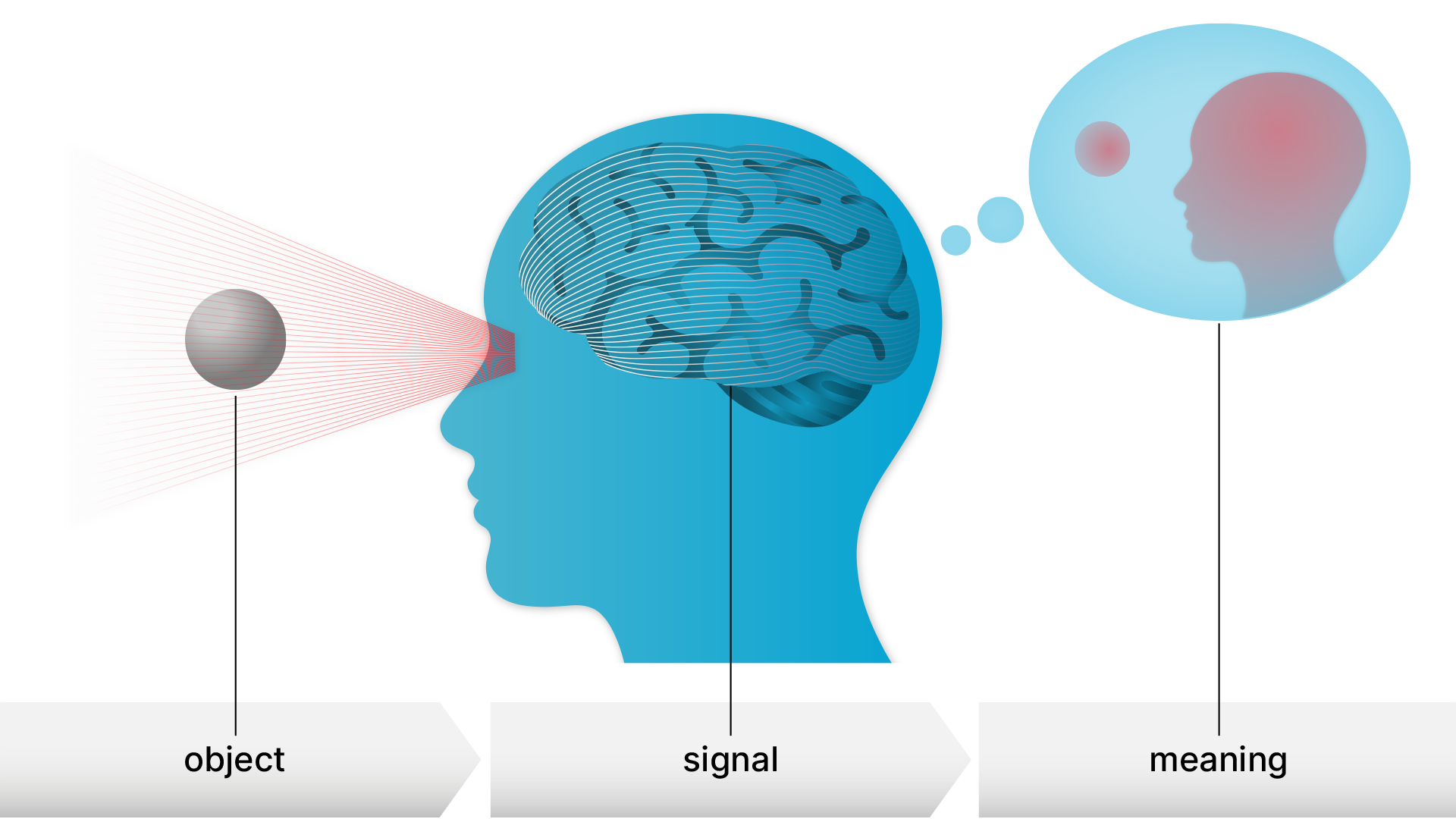
A simple perceptual scenario
We can therefore distinguish between the object in the external world and the perceiving subject’s experience of that object. The difficulty is that we cannot directly compare the object as it exists independently of perception with the subject’s internal experience of it. This forces us to choose between one of two perspectives.
One perspective is to view the scenario “from the outside,” as another person might. From this external, third-person perspective, we can observe the object, the organism’s behaviour, and—using appropriate methods—some of the physical processes involved in perception.
Meanwhile the internal processes of the perceiving subject remain inaccessible and are thus confined to unverifiable speculation.The subject’s internal experience remains inaccessible from an external perspective, raising the problem of other minds: we cannot directly know what another subject experiences. This limitation is well illustrated by the problem of qualia in philosophy and cognitive science.
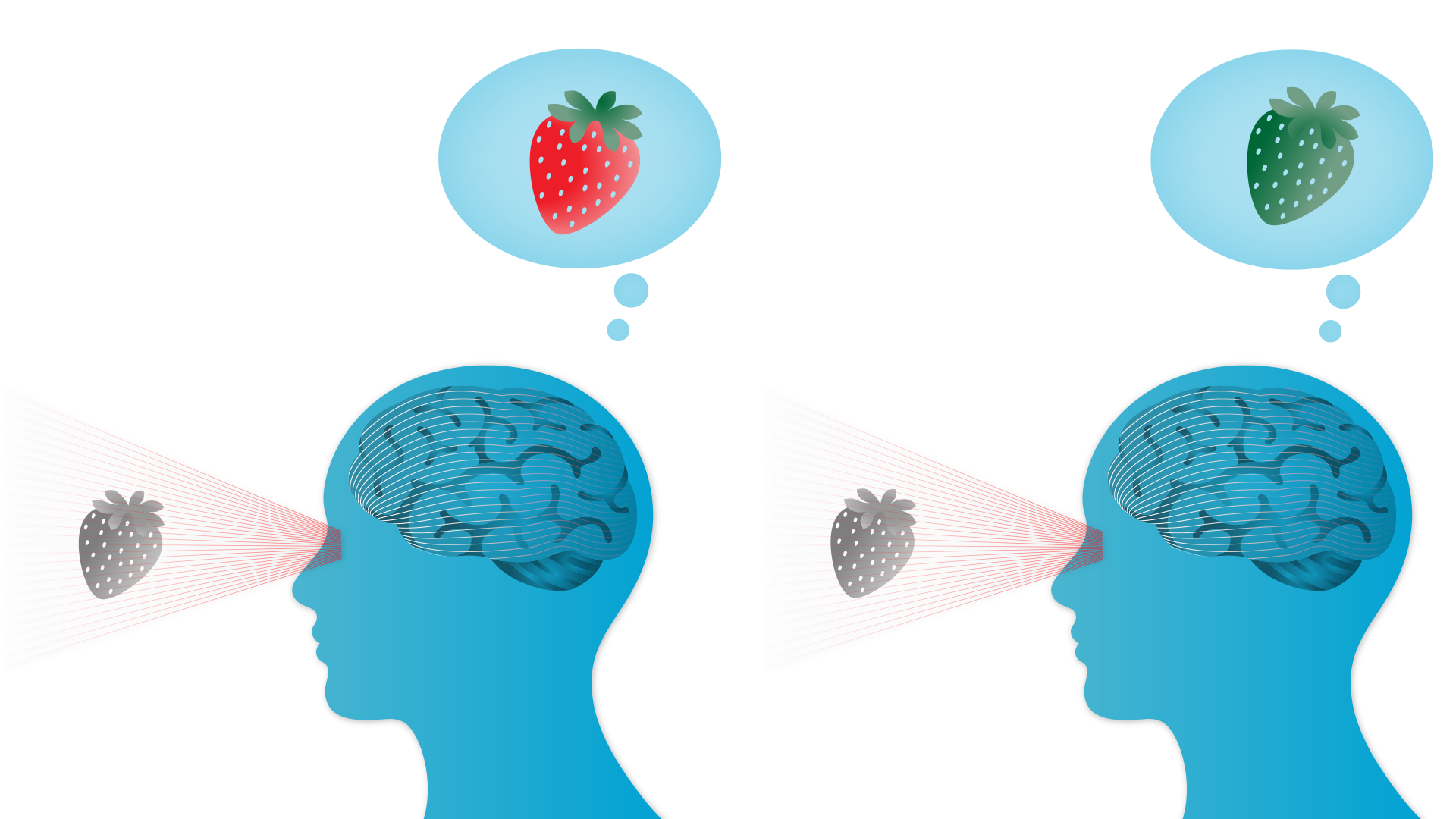
Inverted Qualia
It is impossible to directly perceive what another person experiences. For example, although two people may both describe a strawberry as “red,” one person’s experience of red might resemble what the other experiences as green.. Because both have learned to use the same word, they would have no way of knowing.
Given that the subjective experiences of others are not directly accessible to us, we might initially restrict reality to the material and physical—that which can be observed and agreed upon intersubjectively. On this account, reality is equated with objectivity and approached from a consequentially external perspective. Conversely, internal experiences and other mental phenomena are excluded from what counts as real under this understanding. We will denote this first sense of reality with the index 1:
First Sense of Reality: The Objective
| real1 | unreal1 |
|---|---|
| objective | subjective |
This epistemological position is known as physicalism and is upheld by behaviorism, which considers only observable behavior as a legitimate object of study. John B. Watson, widely recognized as the founder of behaviorism, articulated this view in his 1913 article “Psychology as the Behaviorist Views It,” often referred to as the “behaviorist manifesto.”
Psychology as the behaviorist views it is a purely objective experimental branch of natural science. Its theoretical goal is the prediction and control of behavior. Introspection forms no essential part of its methods, nor is the scientific value of its data dependent upon the readiness with which they lend themselves to interpretation in terms of consciousness.
Watson, 1913, Psychological Review, p. 158
Authors: Fabian Mueller & William Palmer