
THE FOUNDATIONS OF COGNITION
3.2
Motivational Foundation of Behavior
The earliest behaviors were simple, automatic responses – direct movements triggered by stimuli in the environment. While such reflexes involve no cognition, the emergence of internal motivational states marks the first step toward it. Motivation provides the organizing principle of behavior, transforming mere reaction into purposeful action.
One of the earliest and most fundamental examples of automatic, stimulus-driven behavior is phototaxis – movement in response to light. The single-celled organism Euglena possesses an eyespot that detects the direction and intensity of light, enabling it to swim toward illumination that supports photosynthesis. When sufficient light reaches this receptor, the cell orients and moves toward the light source, as illustrated in the figure below. This movement does not involve choice or evaluation, but follows directly from stimulation of the receptor.
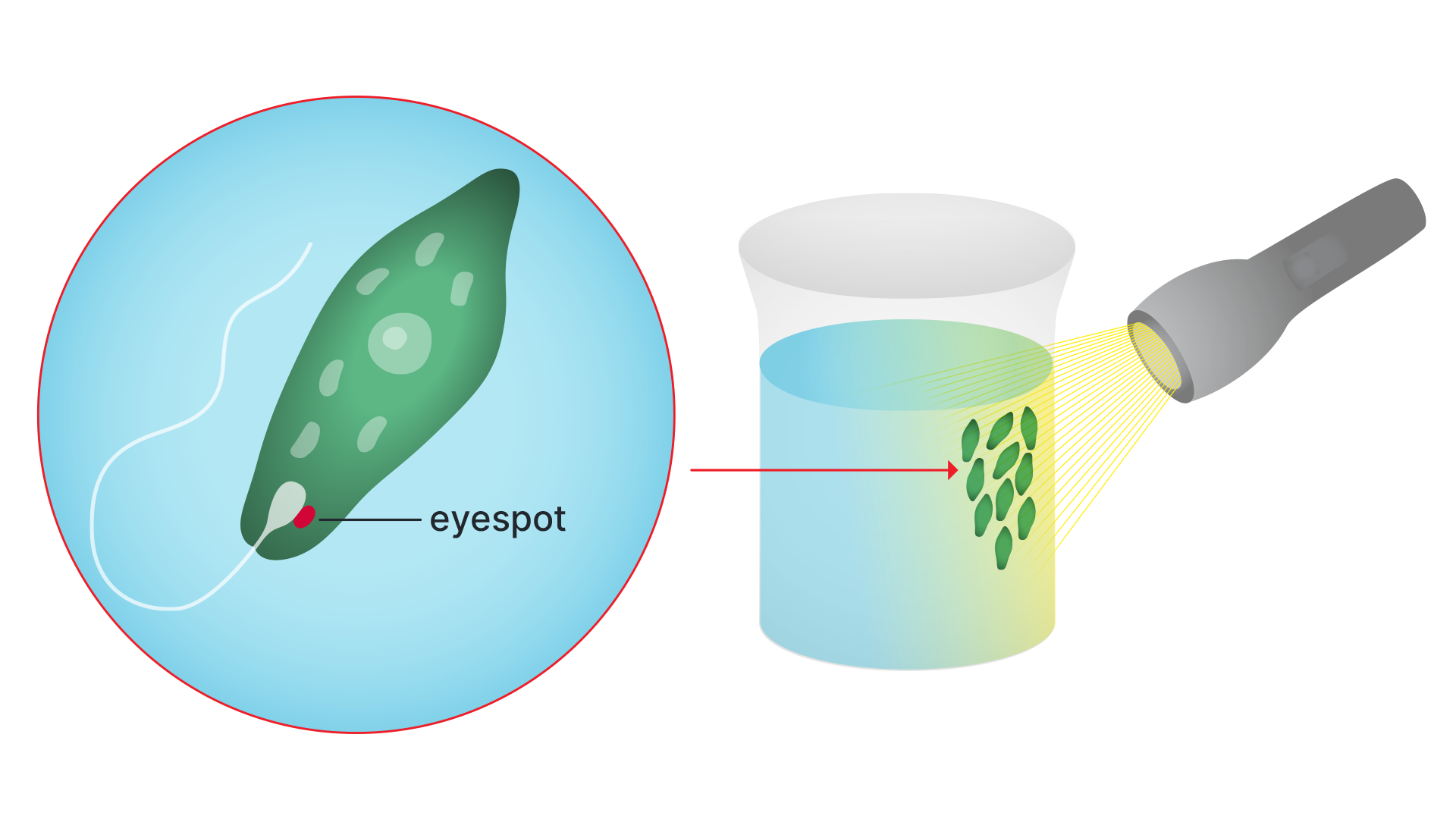
Euglena swimming toward light detected by its eyespot
We call such early behavioral systems reflex arcs – direct, stimulus-bound connections between excitation and motor response. A reflex is invariable, involuntary, and immediate in its reaction to a stimulus, made possible by a neural pathway that can function without involving the brain or conscious awareness. In the case of Euglena, no brain exists at all. Yet even in humans, we find such reflex arcs – the most familiar example being the knee-jerk reflex, where tapping the patellar tendon causes the bent, freely suspended leg to jerk forward automatically.
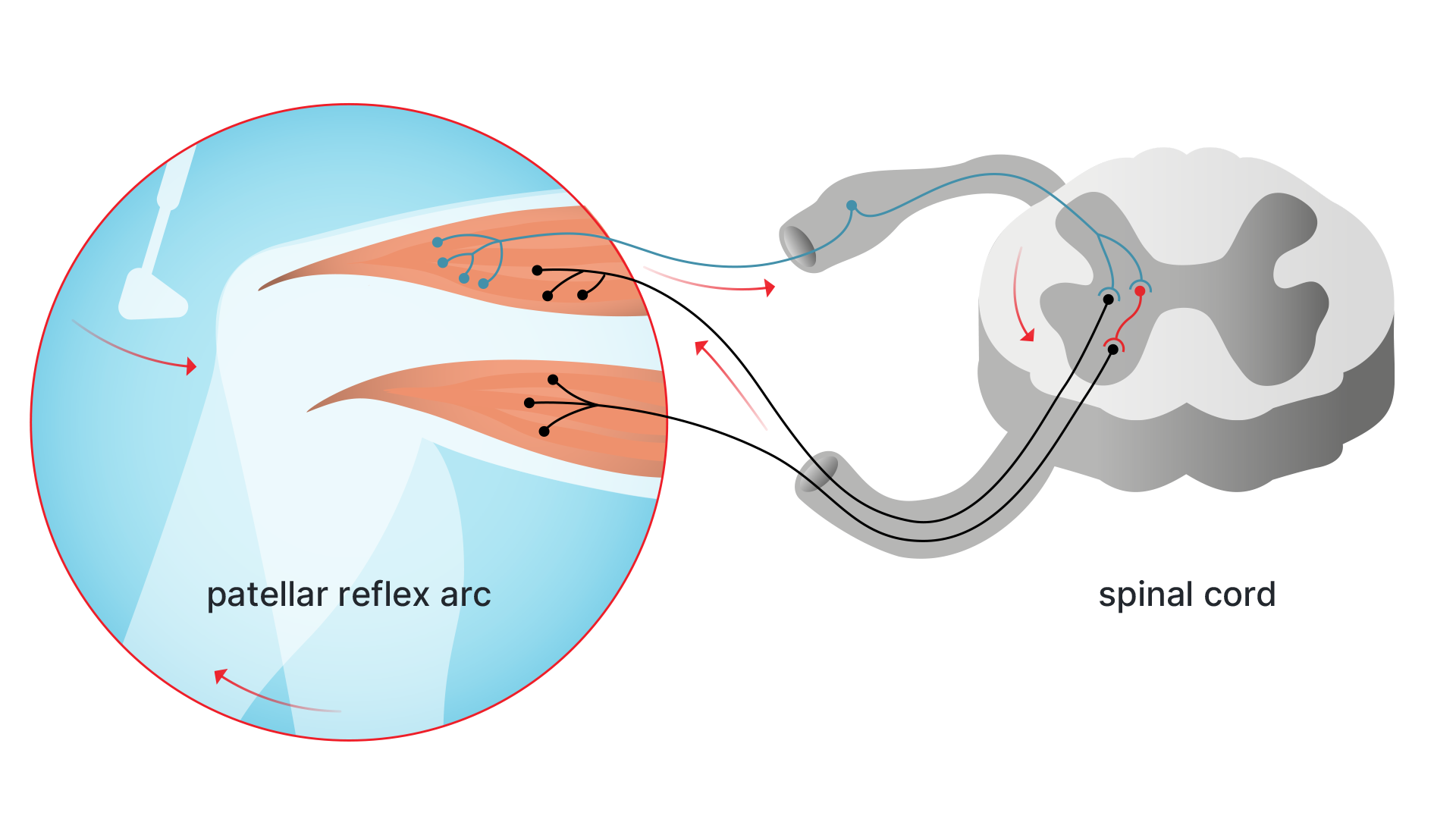
Knee-jerk reflex movement
Such purely reactive behavior alone cannot account for the diversity of behaviors observed in nature. Different environmental challenges require different behavioral responses. A dangerous snake must be avoided. A beneficial nutrient-rich root must be approached. Every living organism must, in one way or another, differentiate between what promotes its survival and what threatens it. To respond appropriately, organisms must distinguish between different kinds of stimuli. In this capacity for differentiation – between beneficial and harmful conditions – we begin to see the first traces of cognition: the invention of the “good” and the “bad”.
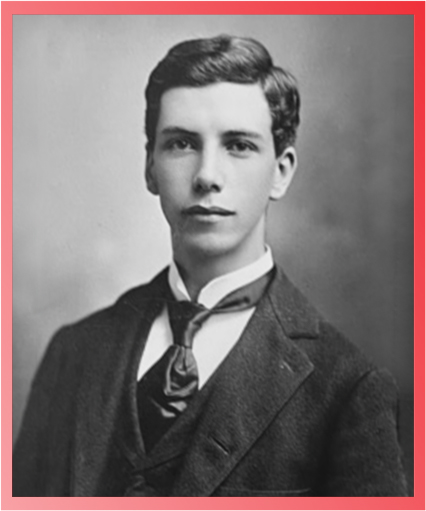
Wallace Craig, Historywalker
CC BY-SA 4.0
In 1918, the American psychologist-ornithologist Wallace Craig overturned the idea that behavior is merely a sequence of reflexes by introducing a motivational foundation that controls behavior. Drawing on observations of pigeons and other birds, he argued in his landmark essay “Appetites and Aversions as Constituents of Instincts” that every instinct begins with an internal state of agitation that motivates behavior until a specific condition is met. He called these internal states appetites (from Latin appetere, “to strive toward,” “to desire” – when the required stimulus is absent) and aversions (from Latin aversio, from avertere, “to turn away” – when an unpleasant stimulus is present). An appetite, he wrote, “continues so long as the appeted stimulus is absent,” and ceases only after a consummatory action brings the organism to rest; an aversion “continues so long as the disturbing stimulus is present” and ends once that stimulus disappears. (Craig, 1918)
Let’s look at this in a bit more detail by spending a morning at a dovecote – first as doves build their nest, then as they react to a predator.
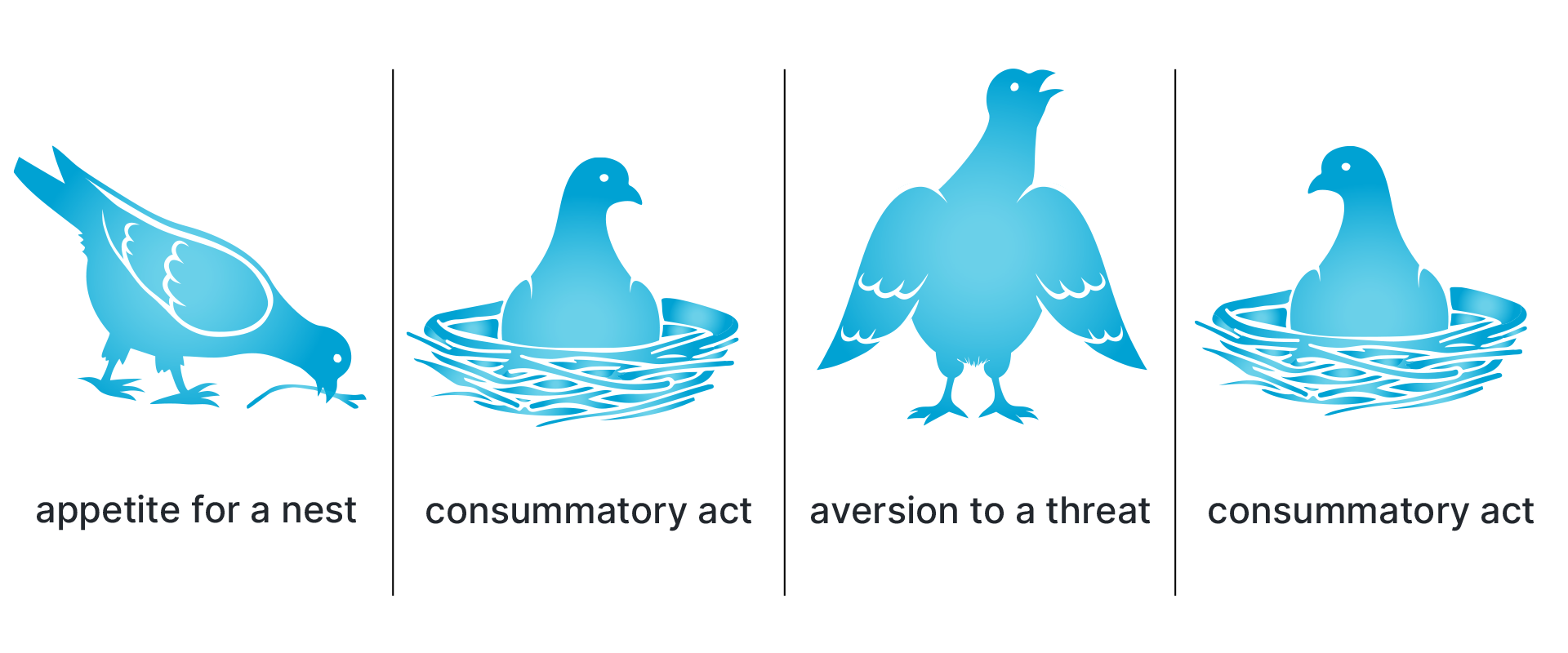 At the dovecote
Sequence of reflexes
| Phase | Internal state | Observable behavior |
|---|---|---|
| Appetite for a nest | An unmet need for a proper nest creates an appetitive tension. | Foraging continues until enough material is gathered. The doves give the nest-calling coo and pace restlessly. The male flies out again and again, collecting single twigs; if one is dropped, he immediately resumes searching. |
| Consummatory act | The tension collapses as soon as the nest is in place. | Appetite satisfied; nest-building stops. The female fits each twig; the pair becomes suddenly calm and shifts to quiet pre-incubation postures. |
| Aversion to a threat | The sight of a rival dove or a hawk triggers an aversive agitation. | The resident male utters a harsh kah call and either attacks the intruder or, failing that, drives his mate away; agitation persists while the threat is present. |
| Consummatory act | The tension collapses once the threat is gone. | Once the intruder retreats or is out of view, the disturbing stimulus disappears and normal brooding resumes. |
Craig’s theory provides one of the earliest explicit links between motivation and evaluative cognition – that is, the organism’s assessment of “good for me” versus “bad for me.”
References
Craig, W. (1918). Appetites and aversions as constituents of instincts. Biological Bulletin, 34(2), 91–107. https://doi.org/10.2307/1536381