
THE FOUNDATIONS OF COGNITION
3.10
Reflections in the Mirror and the Mind
What does it mean to recognize oneself? At some point in evolution and development, organisms became aware of themselves as the ones who acts. This step explores how self-representation develops from rudimentary to more complex forms, how the distinction between the experiencing “I” and the objectified “Me” takes shape, and how this transformation opens the path toward social cognition.
For centuries, philosophers and scientists assumed that animals lived without any notion of themselves as individuals. René Descartes had famously described animals as automata – biological machines driven purely by instinct, lacking consciousness or subjectivity. Even well into the 20th century, this assumption persisted in both psychology and philosophy: animals were thought to perceive, react, and even learn, yet remain unaware of themselves as the agent of their own actions.
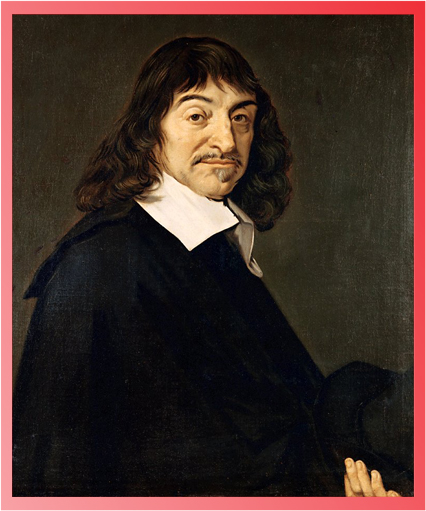
René Descartes (1596–1650), who argued that animals were automata – biological machines lacking consciousness.
He famously used the example of a parrot that imitates human language without understanding it.
Portrait by Frans Hals, Public domain, via Wikimedia Commons.
Today, this view has changed. Experimental research has shown that several species possess at least a rudimentary form of self-recognition. The most influential evidence comes from the mirror test, first developed by psychologist Gordon Gallup in 1970.
In this test, an animal is marked with a small spot of dye on a part of its body it cannot directly see – for example, above the eyebrow.
When the animal is later exposed to a mirror, researchers observe its reaction. Does it try to touch the mark on its own body? Or does it treat the reflection as if it were another individual?

To date, a small number of non-human species – including several great apes, dolphins, an elephant, and Eurasian magpies – have been reported to pass the mirror test. Not all individuals succeed, but many do. They reliably touch or inspect the marked area on their own bodies, suggesting that they recognize the reflection as themselves.
To imagine oneself requires a form of double bookkeeping of the self. One part experiences the body from within. The other acts or appears as a figure within the imagined scene.
To better understand this distinction, we can draw on an idea first formulated by William James.
James distinguished between two aspects of self-awareness: the “I” and the “Me”. The “I” is the experiencing subject. It is the one who experiences; perceives, feels, and acts. It is the felt sense of “I am the one doing this.
The “Me”, in contrast, is the self as object, the self as a thing in the world. It It is the self that can be observed, described, evaluated.
Much like seeing ourselves in a mirror, this sense of self emerges when we reflect on ourselves, imagine how others perceive us, or think about our own traits.
German Psychologist Norbert Bischof developed a related distinction in ethological terms. He spoke of the medial self and the figural self.
The medial self corresponds to the background “I.” It is the implicit center of experience.
The figural self corresponds to the “Me.” It is the self that becomes represented as a figure within one’s own mental model.
Most organisms are likely to remain confined to the medial self – an embodied sense of agency without reflective distance. The emergence of the figural self marks a cognitive milestone. Organisms capable of it can now become both actor and spectator within their own mental simulations. This allows them to mentally try out actions before carrying them out.
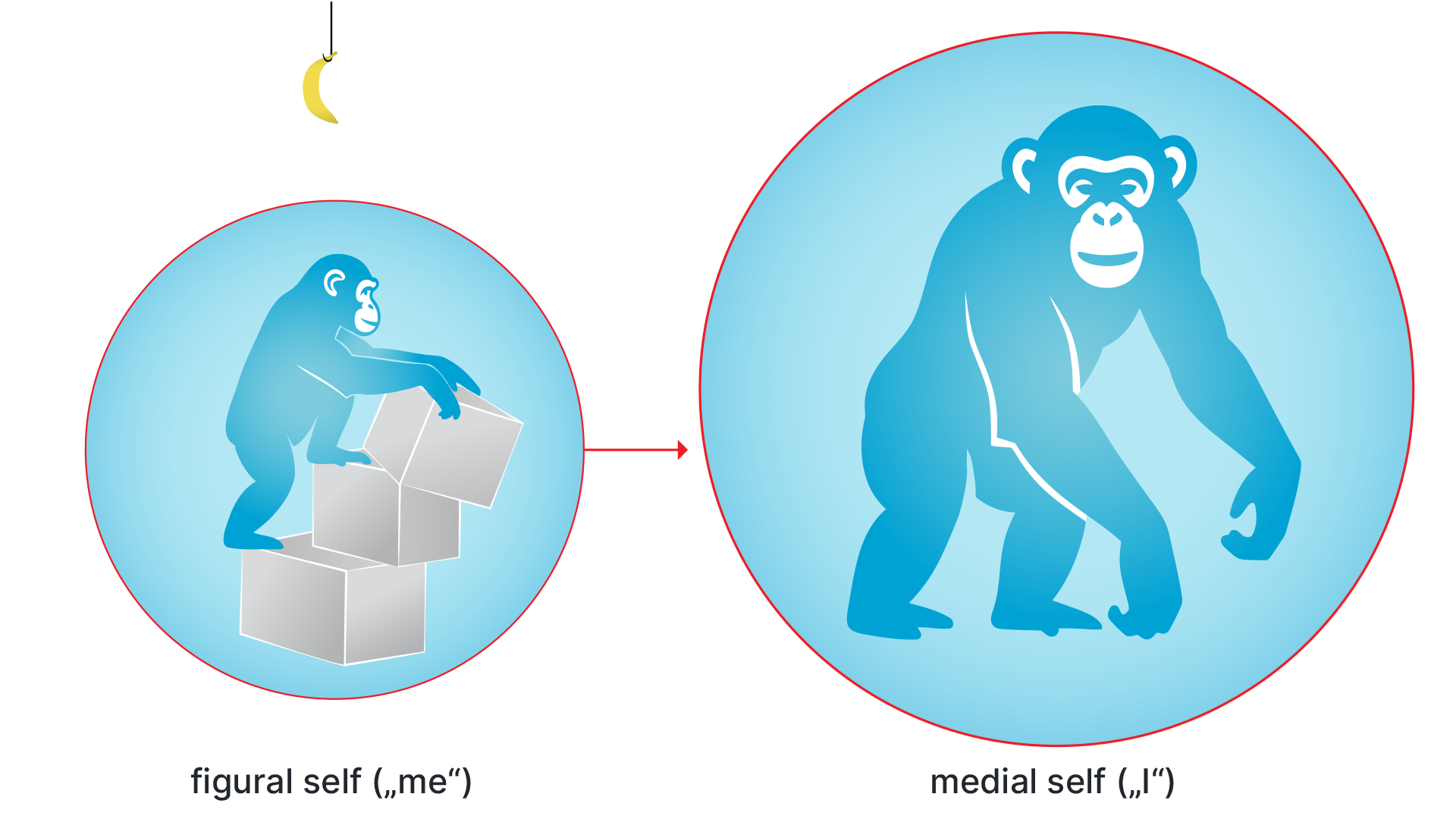
Mental simulation requires a differentiation of the self:
The medial self (“I”) as the experiencing subject, and the figural self (“Me”) as the represented actor within the imagined scene.
Most of the time, we – and presumably all other animals – live primarily within the I: an embodied sense of agency that does not require reflective distance. The emergence of the Me marks a cognitive turning point. An organism becomes both actor and spectator within its own mental simulation. The Me – the figural self – appears when we view ourselves as an object: for example, when we see our reflection in a mirror, imagine how others perceive us, or reflect on our own traits and motives.
The capacity for self-objectification provides a prerequisite for attributing subjectivity to others. This forms the foundation of social cognition. Empathy becomes possible once an organism can separate what it feels from what another individual feels.
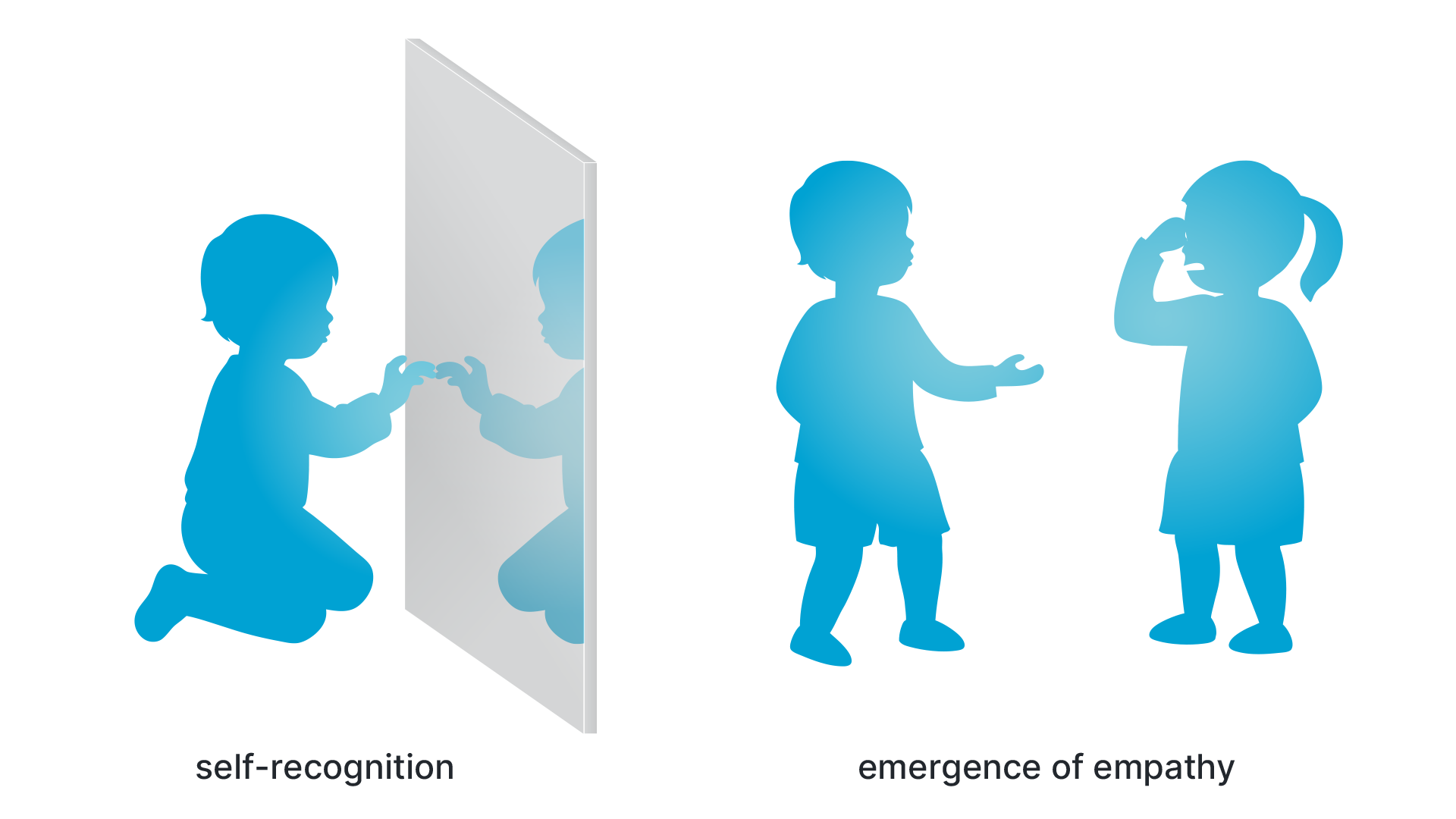
Developmental studies by Bischof-Köhler (1989) demonstrated this link. Toddlers who had just begun to recognize themselves in mirrors also began to respond empathically to the distress of others – comforting, helping, or seeking assistance. Children who had not yet passed the mirror test were more likely to ignore or misinterpret such emotions.
Empathy thus becomes possible with the emergence of the figural self: the awareness that the other’s feeling is not mine, yet can still be sensed.
Author: Fabian Müller
Suggested Media
Chimpanzee mirror test demonstration https://www.youtube.com/watch?v=OsoNKlyFtpI
References
Bischof-Koehler, Doris. Spiegelbild und Empathie. Die Anfänge der sozialen Kognition. Bern u.a.: Huber (1989).
Gallup, G. G., Jr. (1970). Chimpanzees: Self-recognition. Science, 167(3914), 86–87.
James, W. (1890). The principles of psychology (Vol. 1). Henry Holt.
Bischof, N. (2016). Psychologie – Ein Grundkurs für Anspruchsvolle (Rev. ed.). Springer.
Metzinger, T. (2003). Being no one: The self-model theory of subjectivity. MIT Press.