
THE FOUNDATIONS OF COGNITION
3.3
What the Frogs Eye tells the Frogs Brain
Perception is not a passive recording of the world, but an active selection of what matters. In this article, we explore a groundbreaking experiment that showed how a frog’s eye already filters its environment before the brain gets involved.1
On the behavioral level, the distinction between appetence and aversion shapes responses to the environment. Internal states – such as agitation – may underlie and drive these behaviors. But how does an animal actually know what is relevant and what is not, when to act and how to act?
To understand this, let’s take an imaginary stroll to a quiet, damp pond. There, among the reeds and still water, the frogs might just have something to teach us.
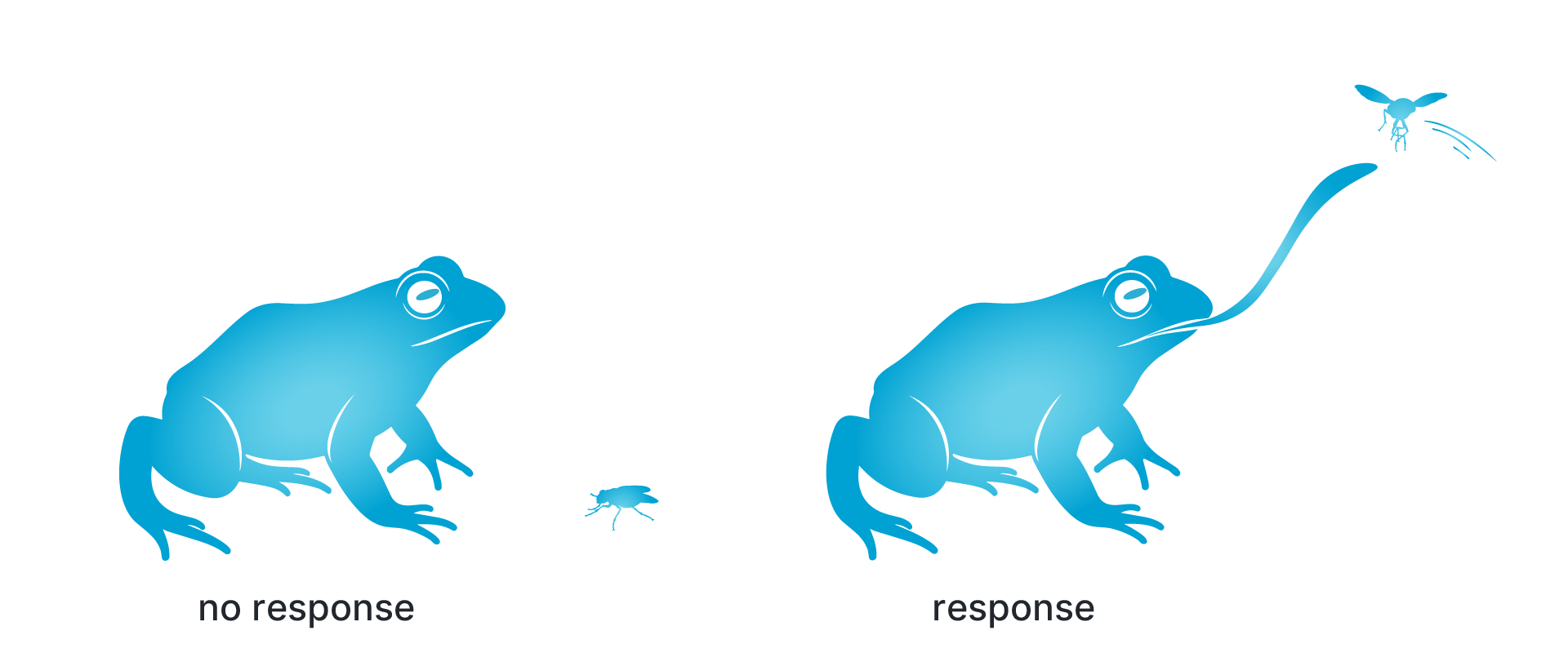
If a fly sits motionless in front of a frog, the frog makes no attempt to catch it. But the moment the fly takes off, the frog’s tongue shoots out and snatches it mid-air. How does the frog know what to do?
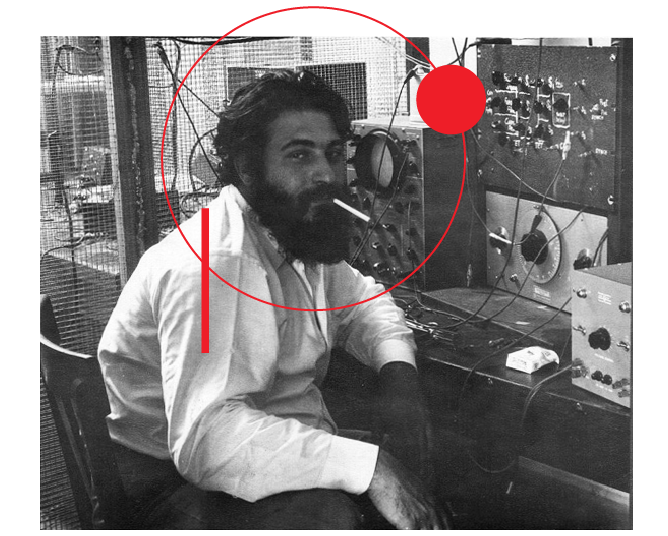
Photograph Y. Lettvin
Attribution-ShareAlike 3.0, CC BY-SA 3.0 https://en.wikipedia.org/w/index.php?curid=4926791
Back in the 1950s, when smoking was still considered cool, Jerome Y. Lettvin and his colleagues at MIT conducted what would become a landmark experiment on the frog’s visual system. At the time, most scientists thought of the eye as a kind of passive camera: it would merely send raw visual images to the brain, where all the “magic” (the actual processing) happened. The view reflected a broader assumption in neuroscience at the time: „The assumption has always been that the eye mainly senses light, whose local distribution is transmitted to the brain in a kind of copy by a mosaic of impulses,“ Lettvin wrote. (Lettvin, 1959; p. 1940)
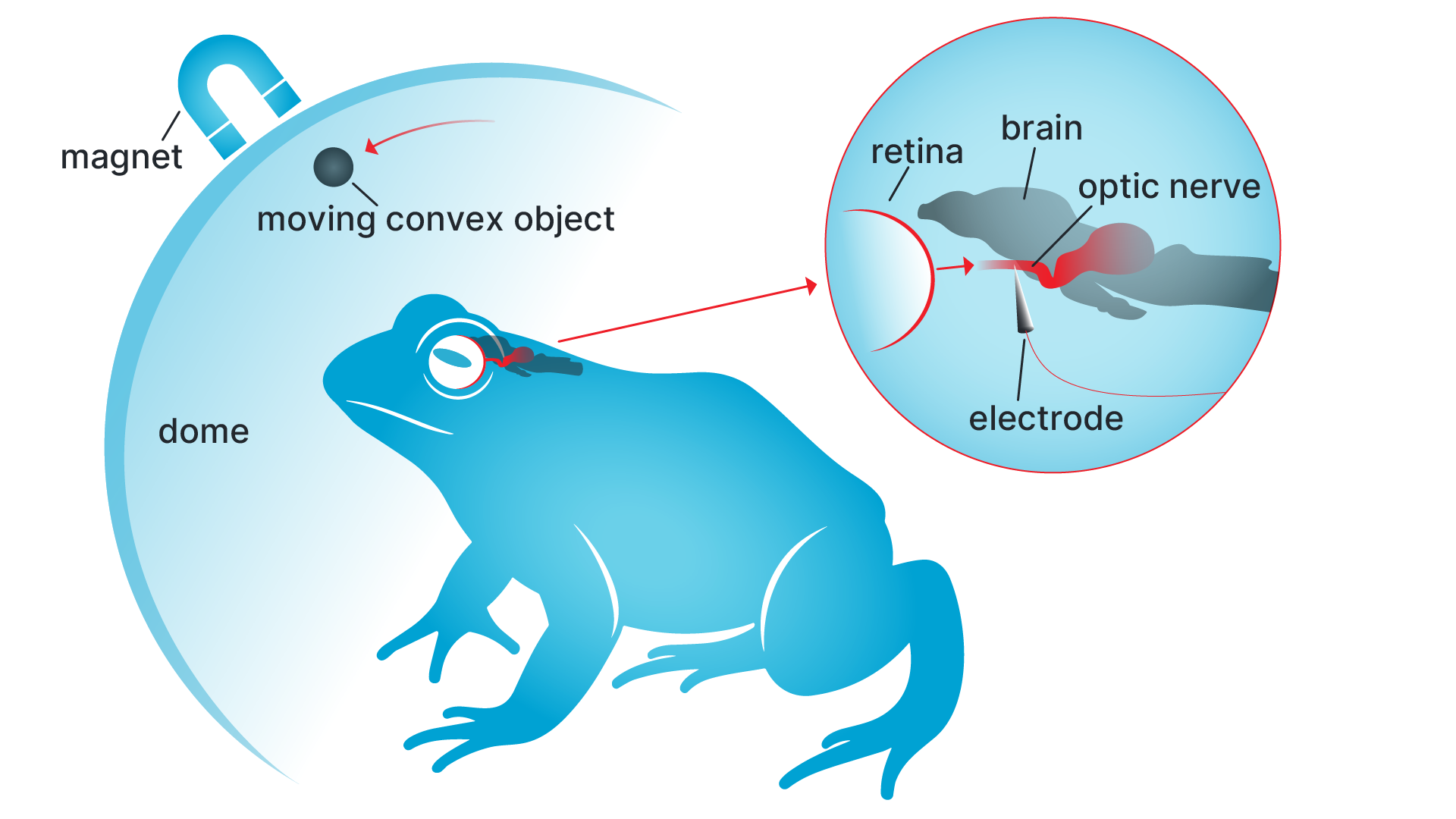
Experimental setup used by Lettvin and colleagues.
Objects were moved across the visual field by magnets outside an aluminium dome, while activity was recorded from the optic nerve.
But instead of taking this for granted, he and his colleagues recorded electrical signals directly from the optic nerve, which carries the output of the retina to the brain. To test what the eye responded to, they placed an aluminum dome around the frog’s eye and moved objects inside it using magnets. They used small black spots or dark convex objects (e.g. circular or oval shapes) moving into the visual field from the periphery, often simulating insect-like motion. All of which, with a bit of frog fantasy, might resemble moving bugs or prey.
Lettvin and colleagues made a remarkable observation. Certain neurons in the frog’s retina responded highly selectively to small, convex objects moving into their receptive field (the specific area of the visual field to which a neuron is sensitive). These neurons would fire only when the object entered the field from outside, and only if the contour was convex. They did not fire for static objects, concave contours, or sudden appearance (flickering shadows) within the field.
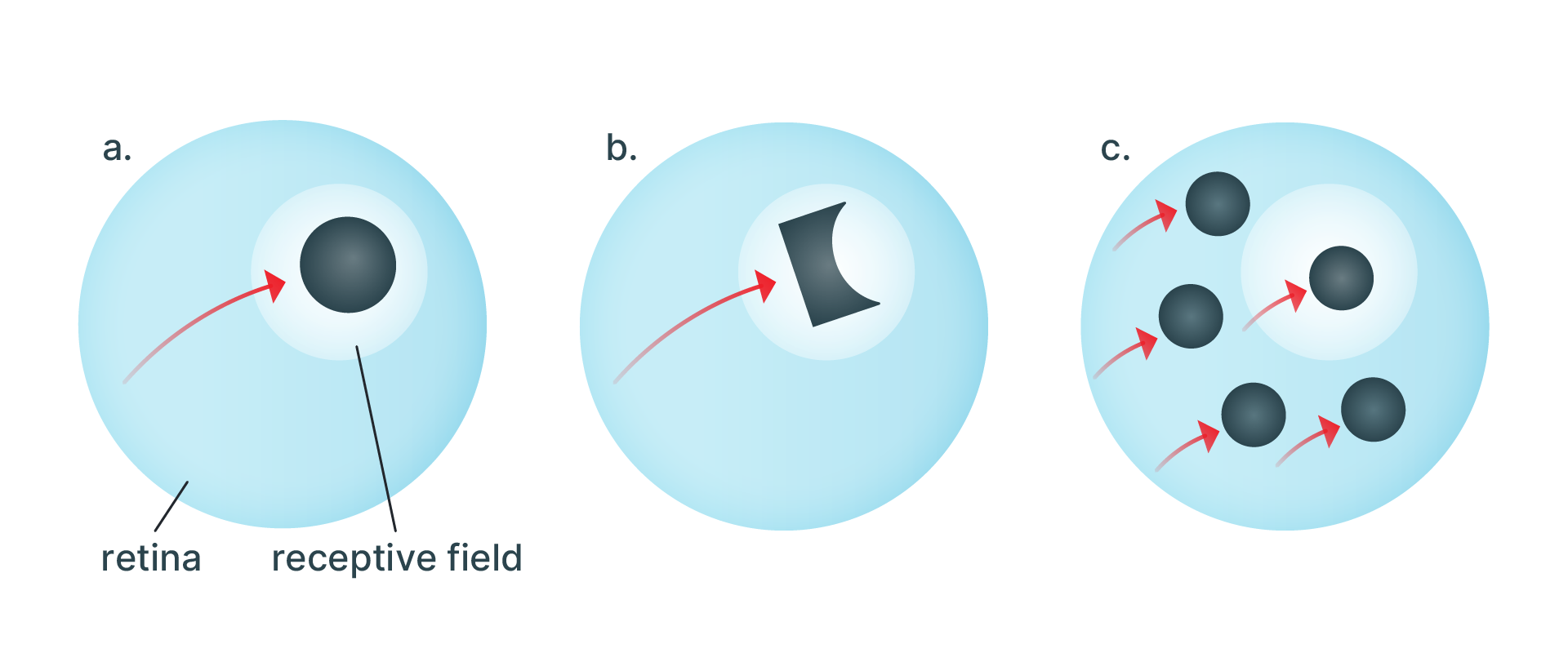
a) proper activation when a convex, dark object moves into the receptive field
b) no response to a concave object
c) no response when many contours move in the same direction simultaneously.2
Jokingly, Lettvin called these cells “bug detectors.” And indeed, their tuning was remarkably precise: the optimal stimulus size matched that of a fly at a snackable distance. But perhaps most strikingly: this filtering happened in the eye itself. Before the brain ever received the signal, the retina was already selectively signalling “Hey, here’s something you should pay attention to.” So, Lettvin and his colleagues found that many processes previously believed to occur in the brain were, in fact, already taking place in the eye. As he put it, „The eye speaks to the brain in a language already highly organized and interpreted, instead of transmitting some more or less accurate copy of the distribution of light on the receptors.“ (Lettvin, 1959; p. 1940)
Box: What we can learn from these experiments is that the frog’s brain doesn’t even need to form any concept of “fly” versus “other object.” It likely didn’t even need to understand what a fly is, or to “think” about it in any overly conceptual sense. Instead, the eye was already performing a first layer of selective processing – filtering out shapes and motions that mattered from those that didn’t, selectively encoding patterns in the environment that carried behavioral significance. This discovery marked a major turning point in how scientists began to think about how information processing is organized.
At the time, Lettvin’s discovery was seen as so surprising that no major journal wanted to publish it. Thus, the paper first appeared in a fairly obscure outlet, under a title that might have been deliberately provocative: “What the Frog’s Eye Tells the Frog’s Brain.”
Today, the publication is regarded as a classic in the history of neuroscience and amongst the most cited scientific papers.
Author: Fabian Müller
Suggested Media
Here is a YouTube Link that offers a glimpse into how cats might perceive the world: www.youtube.com/watch?v=E5EkB4sQ_y4&ab_channel=FelineFanatics
Or also take a look at this website from the Animal Cognition & Learning Lab at Tufts University in Massachusetts: https://pigeon.psy.tufts.edu/psych26/umvelt.htm.
References
Lettvin, J. Y., Maturana, H. R., McCulloch, W. S., & Pitts, W. H. (1959). What the frog’s eye tells the frog’s brain. Proceedings of the IRE, 47(11), 1940–1951, quote on p. 1940.
Bischof, Norbert. Psychologie. Ein Grundkurs für Anspruchsvolle. Kolhammer, Stuttgart, 3. Auflage 2014