
THE FOUNDATIONS OF COGNITION
3.8
A Rats’ Map and Banana Fantasies
How do animals solve problems without relying solely on trial and error or reinforcement? This step explores pioneering work by Tolman and Köhler, showing that both rats and apes can solve problems by forming internal representations of their environment – and using them to guide action.
Following Pavlov, Thorndike, and Skinner, learning was largely understood as a matter of associations – organisms linking stimuli and responses through reinforcement. Within this framework, behavior was shaped by past outcomes: actions followed by reward became more likely, while those without reward faded away.
However, a number of experiments revealed forms of learning that could not be fully accounted for by simple stimulus–response associations. In these cases, animals appeared to acquire knowledge that was not immediately expressed in behavior and not directly reinforced at the moment it was learned.
Through his famous maze experiments with rats in the late 1940s, American psychologist Edward Tolman observed behavior that challenged this associative framework. In these experiments, rats were allowed to explore a maze freely, without receiving any rewards. During this exploration phase, their behavior appeared unremarkable – there was no visible sign of learning.
However, when food was later introduced into the maze, these rats quickly navigated directly to it – much faster than rats that had not previously explored the maze. Tolman concluded that the animals must have learned something during the unrewarded exploration phase. They had formed an internal representation of the maze’s layout – a cognitive map – which they could later use flexibly to guide their behavior.
Rather than simply strengthening stimulus–response links through reinforcement, the rats appeared to acquire knowledge about the structure of their environment, even when that knowledge was not immediately expressed in action.1
What This Shows
Tolman proposed that learning is not merely a matter of forming stimulus–response associations, but can involve constructing internal representations of the environment. These representations allow behavior to be guided flexibly toward goals, even when learning occurs without immediate reward.
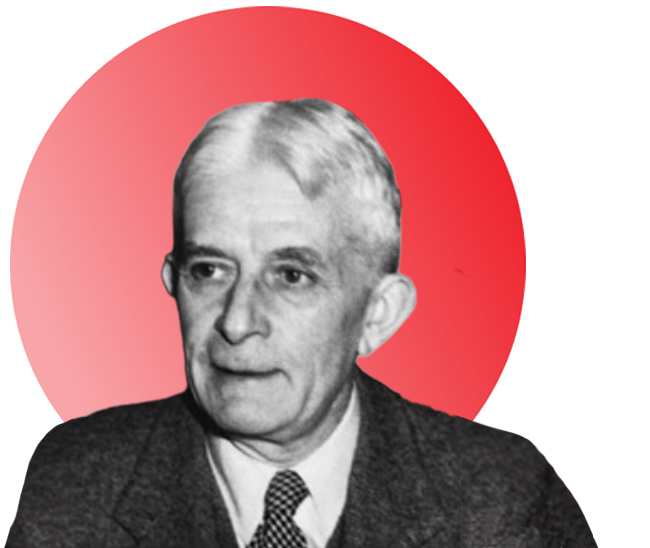
Wolfgang Köhler
Historical Library, Swartmore College /The National Academies Press
CC BY-SA 2.5 https://creativecommons.org/licenses/by-sa/2.5, via Wikimedia Commons
Under very different circumstances, Wolfgang Köhler arrived at similar – but even more striking – observations in another species, one much closer to our own.
Stranded on the Canary Islands during the First World War, Köhler studied a small group of apes in what he called their “playground.” The animals were provided with a variety of objects – such as boxes, poles, and sticks – that they could freely explore and manipulate. Köhler presented the apes with a series of problem-solving tasks, each involving food that was visible but not directly accessible.
Rather than training the animals through repeated reinforcement, Köhler observed how they approached these problems spontaneously, relying on the available objects in their environment.
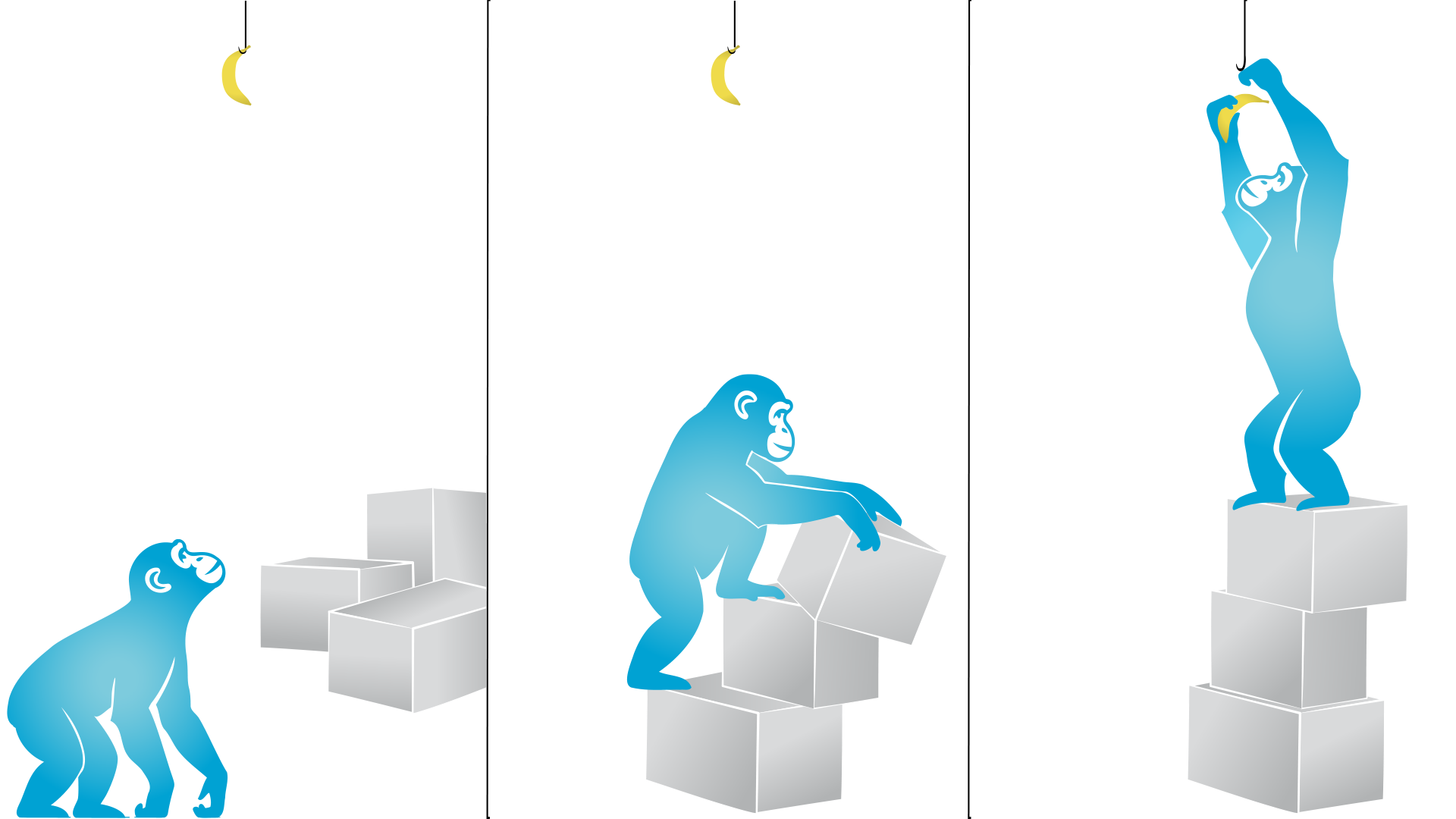
In many of Köhler’s experimental setups, a banana was suspended from the ceiling, well out of reach for the apes. The task was always the same: to retrieve the banana. Some observations of the chimpanzee Sultan, the most intelligent member of the small colony, were particularly revealing for Köhler.
In one such instance, Sultan initially made several unsuccessful jumping attempts to reach the food, displaying trial-and-error behavior similar to that observed in the cats from Thorndike’s puzzle box experiments. After a number of attempts, however, Sultan stopped. He sat still, apparently inactive. After a short pause – what could almost look like a moment of thinking – Sultan dragged one box beneath the banana, climbed onto it, then stacked a second box on top. Once the tower was stable, he climbed up and retrieved the fruit.2
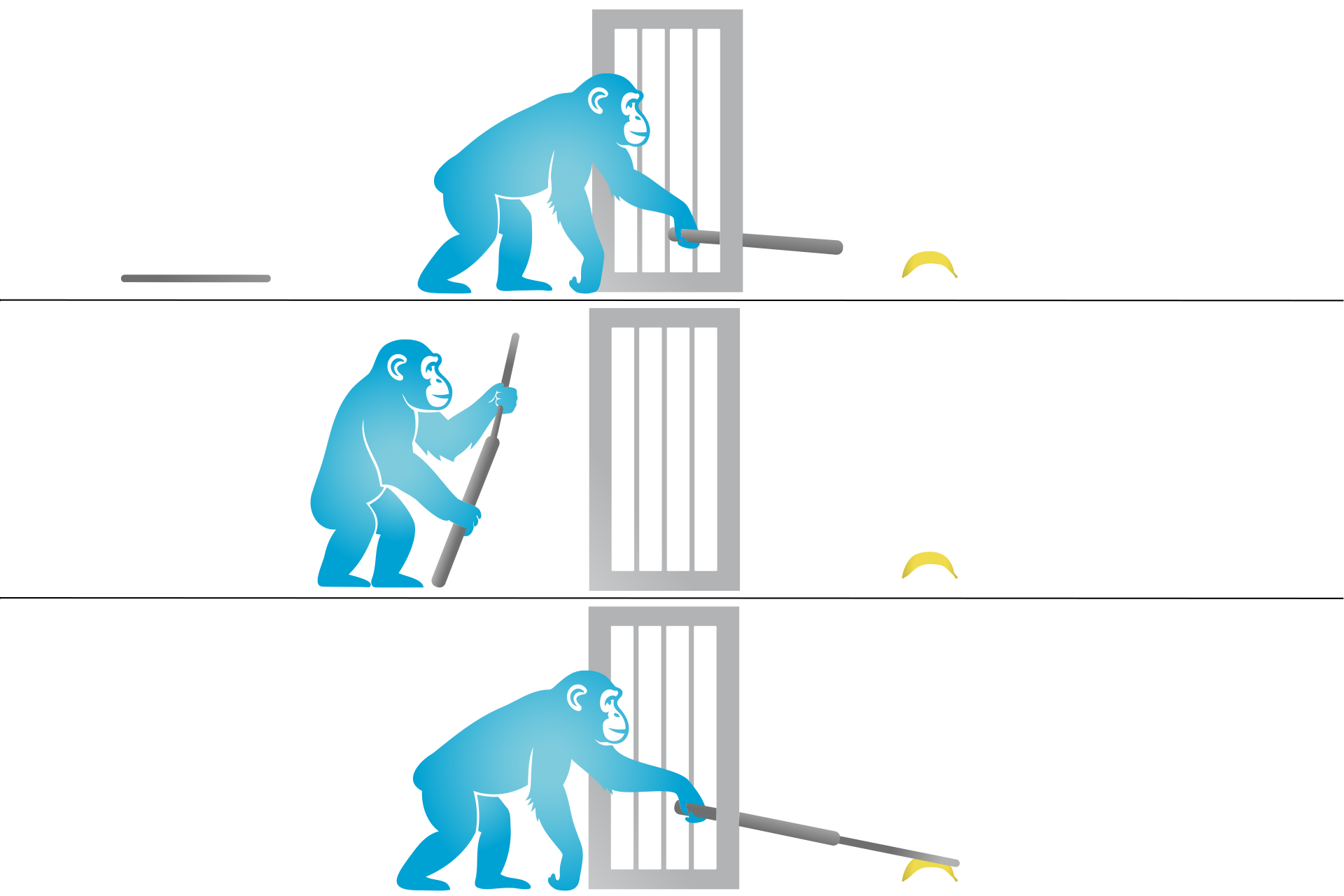
Another trial involved retrieving a banana placed outside the cage using two sticks. Each stick was too short on its own, but together they could be extended to the required length by inserting one into the other. Sultan discovered this solution and mastered it with ease, whereas the other members of the group were overwhelmed by the task.
The common theme across these observations is that, by all appearances, Sultan was not solving the problems through trial and error. His behavior was not shaped by immediate reward or punishment. Instead, his actions suggested a different mode of problem solving.
Taken together, these observations point to more than the mere presence of an internal representation. Tolman’s rats appeared to acquire a map-like representation of their environment. Sultan, by contrast, showed the ability to actively reorganize and test possible actions before carrying them out. The solutions did not emerge gradually through repeated attempts. They appeared suddenly, as if the problem had been worked through internally.
For much of the 20th century, many psychologists and philosophers assumed that the ability to imagine – to simulate actions mentally – was uniquely human. Tolman’s and Köhler’s observations suggest otherwise. Rats form internal representations of their environment. Apes can mentally play through a strategy to reach their bananas.
In both cases, behavior was guided not only by trial and error or simple associations. It was guided by internal processes that allowed outcomes to be explored before actions were performed. These internal simulations enabled animals to anticipate consequences before acting in the world.
What This Shows
From an evolutionary perspective, this marks an important elaboration of cognition – what might be called a reality simulator. It is the ability to imagine and plan actions in advance, and to evaluate possible outcomes before acting.
This cognitive milestone is known as mental simulation. It enables organisms to anticipate consequences and compare potential courses of action before they are carried out.
Author: Fabian Müller
Suggested Media
For those who enjoyed learning about the cognitive abilities of various animals, here is a wonderful documentary by Arte (in German) that showcases some of the most impressive cognitive feats across the animal kingdom: https://www.youtube.com/watch?v=J6rACspQetY
References
Bischof, N. (2016). Psychologie – Ein Grundkurs für Anspruchsvolle (Rev. ed.). Springer. (Chapter 13.1: “Die Simulation der Wirklichkeit,” pp. 349–356)
Köhler, W. (1925). The mentality of apes (E. Winter, Trans.). Harcourt, Brace. (Original work published 1917)
Tolman, E. C. (1948). Cognitive maps in rats and men. Psychological Review, 55(4), 189–208.
-
To understand the layout of the experiment, watch this video: https://www.youtube.com/watch?v=qb7PBl17hy4 ↩
-
Watch here some of the original footage of these experiments: https://www.youtube.com/watch?v=FwDhYUlbxiQ ↩