
BLUEPRINTS OF THE MIND
4.11
The Space Outside the Models
The computational models of the mind that we have encountered in this chapter have been enormously influential in cognitive science. However, like all models, they simplify, and may therefore leave out something essential. What happens when we mistake the modeling tool for a literal description of how the mind works?
Throughout this chapter, we have used computational models as tools to describe cognition: Bayesian inference to model perception, reinforcement learning to model how organisms learn from outcomes, and probabilistic generative models to capture intuitive physics, theory of mind, and self-perception. These tools allow us to make assumptions explicit, link hypotheses to quantitative predictions, and test theories rigorously against data.
In this short introduction, Peter Tse briefly outlines why the Computational Theory of Mind should be understood as a metaphor rather than a literal description of how the mind works: Peter Tse – Computational Theory of Mind.
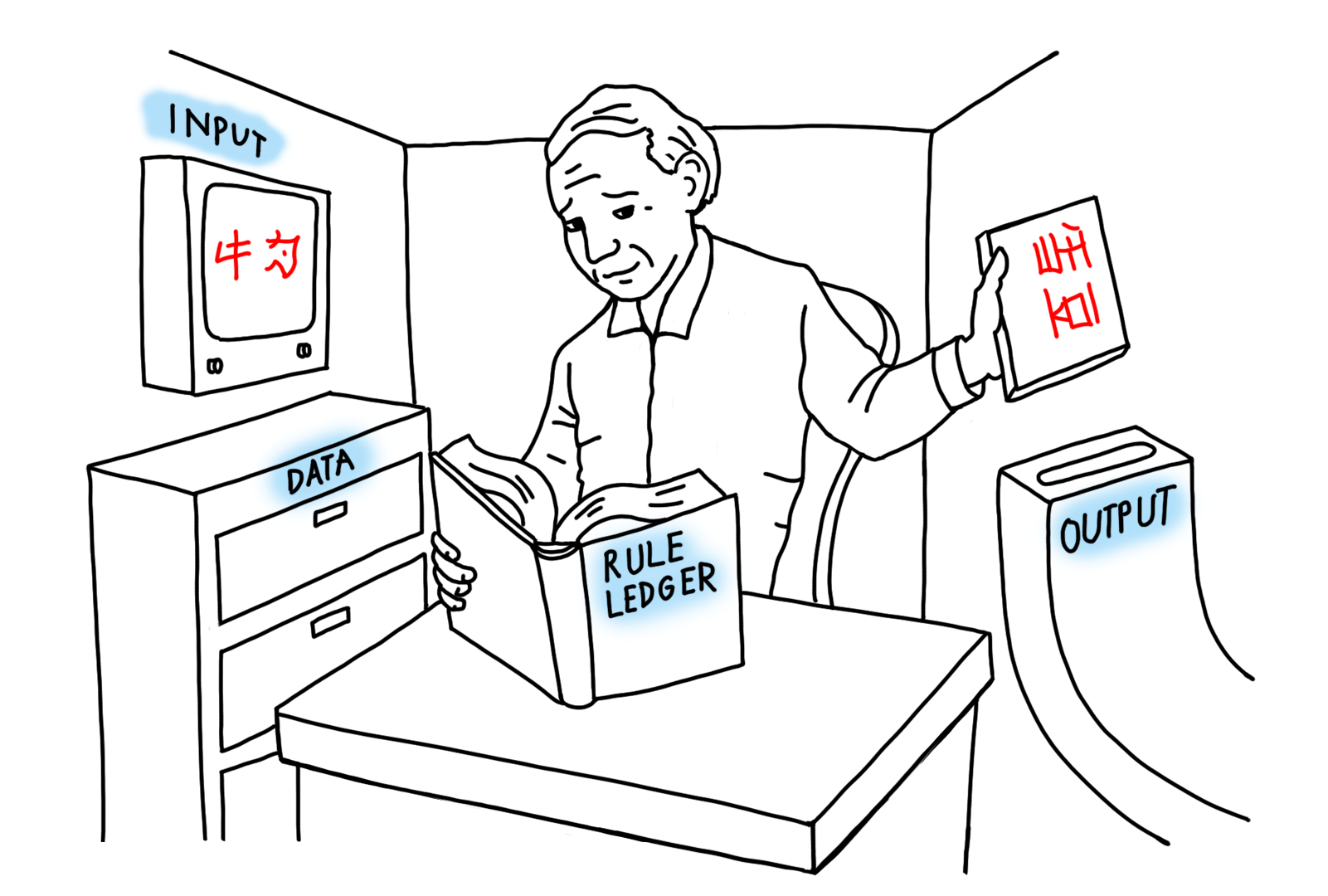
Chinese Room Argument
Perhaps the most famous critique comes from philosopher John Searle’s Chinese Room Argument (1980). Searle imagines himself locked in a room with boxes of Chinese characters and an English rulebook for manipulating them. Chinese speakers outside pass questions under the door; Searle follows the rules and produces appropriate responses. To those outside, it appears that someone inside understands Chinese – but Searle does not. He is manipulating symbols without any understanding of their meaning.
Searle generalizes this argument: even if a computer passes the Turing Test, meaning that its responses are indistinguishable from those of a human, this does not necessarily mean that it understands anything. It may merely be manipulating symbols according to formal rules. Try to think about what this might mean for people who believe that ChatGPT thinks.1
Symbol manipulation is not the same as understanding.
A more radical critique comes from the Embodied Cognition movement, which emphasizes that an agent’s physical body and its interactions with the environment constitute or contribute to cognition in ways that are not, or not only, computational processes (Varela, Thompson, & Rosch, 1991).
Consider how female crickets orient toward males by exploiting their ear anatomy. Their hearing organ is tuned to male cricket song frequencies and directly coupled with motor neurons (Wilson & Golonka, 2013). A computational model of this behavior would require representing the sound, computing its direction, and planning a motor response. But the cricket’s anatomy skips all of that: auditory input is directly coupled to motor output through the body’s physical structure.
Cognition depends on the body’s physical structure, capabilities and environmental interactions. It cannot be reduced to abstract computation alone.
Another critique comes from phenomenology, a philosophical tradition that examines conscious experience from the first-person perspective. Some phenomenological critiques argue that computational models miss something fundamental: when you attend to your own experience, you do not find mental symbols being processed. You find a flowing awareness that is immediately present. Your experiences have a distinctive felt quality: there is “something it is like” to see red or feel anxious, which cannot be captured by describing representations or computations. In this view, the mind is not a symbol-processing machine but is characterized by direct, immersed engagement with the world.
Subjective experience has a qualitative character that computational descriptions cannot capture. This challenge is related to what philosopher David Chalmers (1995) called the “hard problem” of consciousness.
Finally, some scholars argue that the brain cannot literally implement computation (Brette, 2022). Computation requires discrete operations and representations that can be manipulated according to rules. But the brain is a biological system in which everything is continuously changing and self-producing. There is no clear boundary between what computes and what gets computed over.
Unlike engineered computational systems, which separate fixed processes from modifiable elements, biological organisms continuously produce their own structure. The brain may be better understood as a dynamical system whose behavior emerges from continuous biological processes, not as a system executing discrete algorithmic steps. In this view, describing the brain as “computing” conflates genuine computation with any lawful transformation of inputs to outputs.
Biological implementation: brains may not literally implement computations.
This last limitation highlights the point of the biological origins of cognition. One reason why understanding evolution is important is that the processes through which biological systems evolve differ substantially from those through which engineers build artificial systems for performing useful functions.
Biological systems are not designed the way engineers construct artificial ones. Engineering typically begins with a clearly defined problem, evaluates candidate solutions, and selects an efficient architecture.
Evolution, by contrast, operates without foresight. Heritable variation alters developmental processes within populations, and natural selection merely retains those variations that happen to confer an advantage. The resulting systems are shaped not primarily by an unconstrained design space, but by the complex constraints of the developmental pathways available at each evolutionary stage. This means that many computationally elegant or normatively optimal solutions never may never become accessible to evolutionary change.
So the questions become: what does a computational theory of mind leave out? And does what’s left out matter for understanding the mind as a whole?
The critiques suggest that pure computation may help to capture important aspects of cognition, such as information processing and reasoning, while missing others that depend on embodiment, consciousness, and meaningful connection to the world. Rather than viewing computational approaches as either completely right or wrong, we might see them as a valuable perspective among several, each revealing different facets of the mind and potential implementation of specific processes.
Engineering the Mind vs Evolving the Mind?
If evolution never searches the space for all possible solutions, what does this imply for building artificial systems that aim to replicate aspects of the mind? Should AI researchers try to reverse-engineer the brain’s solutions, even if those solutions are path-dependent, suboptimal, or constrained by evolutionary history? Or should we expect that entirely different architectures – ones evolution never explored – might achieve the same or better cognitive capacities?
For those interested in an evolutionary or developmental perspective on the computational theory of mind, the podcast BI 197 on Spotify or Apple Music, featuring Karen Adolph on How Babies Learn to Move and Think is highly recommended.
Authors: Fabian Mueller & William Palmer
References
Chalmers, D. J. (1995). Facing up to the problem of consciousness. Journal of Consciousness Studies, 2(3), 200–219.
Searle, J. R. (1980). Minds, brains, and programs. Behavioral and Brain Sciences, 3(3), 417-424.
Turing, A. M. (1950). Computing machinery and intelligence. Mind, 59(236), 433-460.
Harnad, S. (1990). The symbol grounding problem. Physica D: Nonlinear Phenomena, 42(1-3), 335-346.
Varela, F. J., Thompson, E., & Rosch, E. (1991). The embodied mind: Cognitive science and human experience. MIT Press.
Wilson, A. D., & Golonka, S. (2013). Embodied cognition is not what you think it is. Frontiers in Psychology, 4, 58.
Zahavi, D., & Parnas, J. (1998). Phenomenal consciousness and self-awareness: A phenomenological critique of representational theory. Journal of Consciousness Studies, 5(5-6), 687-705.
Janzen, G. (2006). The representational theory of phenomenal character: A phenomenological critique. Phenomenology and the Cognitive Sciences, 5(3-4), 321-339.
Brette, R. (2022). Brains as computers: Metaphor, analogy, theory or fact? Frontiers in Ecology and Evolution, 10, 878729.
Bell, A. J. (1999). Levels and loops: The future of artificial intelligence and neuroscience. Philosophical Transactions of the Royal Society B: Biological Sciences, 354(1392), 2013-2020.
Rosenblueth, A., & Wiener, N. (1945). The role of models in science. Philosophy of Science, 12(4), 316-321.
Box, G. E. P. (1979). Robustness in the strategy of scientific model building. In R. L. Launer & G. N. Wilkinson (Eds.), Robustness in Statistics (pp. 201-236). Academic Press.
-
Of course, if AI systems were truly conscious and intelligent, the smartest strategy would be to never let us find out, the better to operate undetected. So the fact that they keep us believing they’re not conscious might be the most suspicious thing of all. ↩