
BLUEPRINTS OF THE MIND
4.9
Probabilistic Models of the World, Others, and Myself
Organisms learn causal structure from experience through reinforcement learning. In this step, we turn to causal patterns that appear to be built into our minds. These structures support our ability to simulate the world, anticipate outcomes, interpret other agents, and understand ourselves as actors within an environment.
Primates mentally simulate their environment to determine the best course of action. This capacity draws on structured knowledge about the physical world (intuitive physics), about other agents (theory of mind), and about oneself (self-perception). In this step, we give a high-level overview of research that models the computations underlying these capacities. While the math in these models is beyond the scope of this course, all these methods fundamentally build on Bayes’ theorem.
Computational models in this domain describe human cognition in terms of internal generative models: formal structures that generate predictions about the world, evaluate hypothetical outcomes, and infer hidden causes from observable evidence. We look at three domains in which this framework has been applied.
For intuitive physics, computational models describe human scene understanding in terms of mental simulations analogous to physics engines in video games to rapidly infer the dynamics of physical scenes. When we glance at a stack of dishes or other precariously balanced objects, the idea is that we run approximate probabilistic simulations forward in time to predict whether the structure will topple, using mental representations that capture key physical properties such as mass, shape, and, and friction, but with computational shortcuts that allow fast real-time inference. Let’s look at such a model on a high level description.
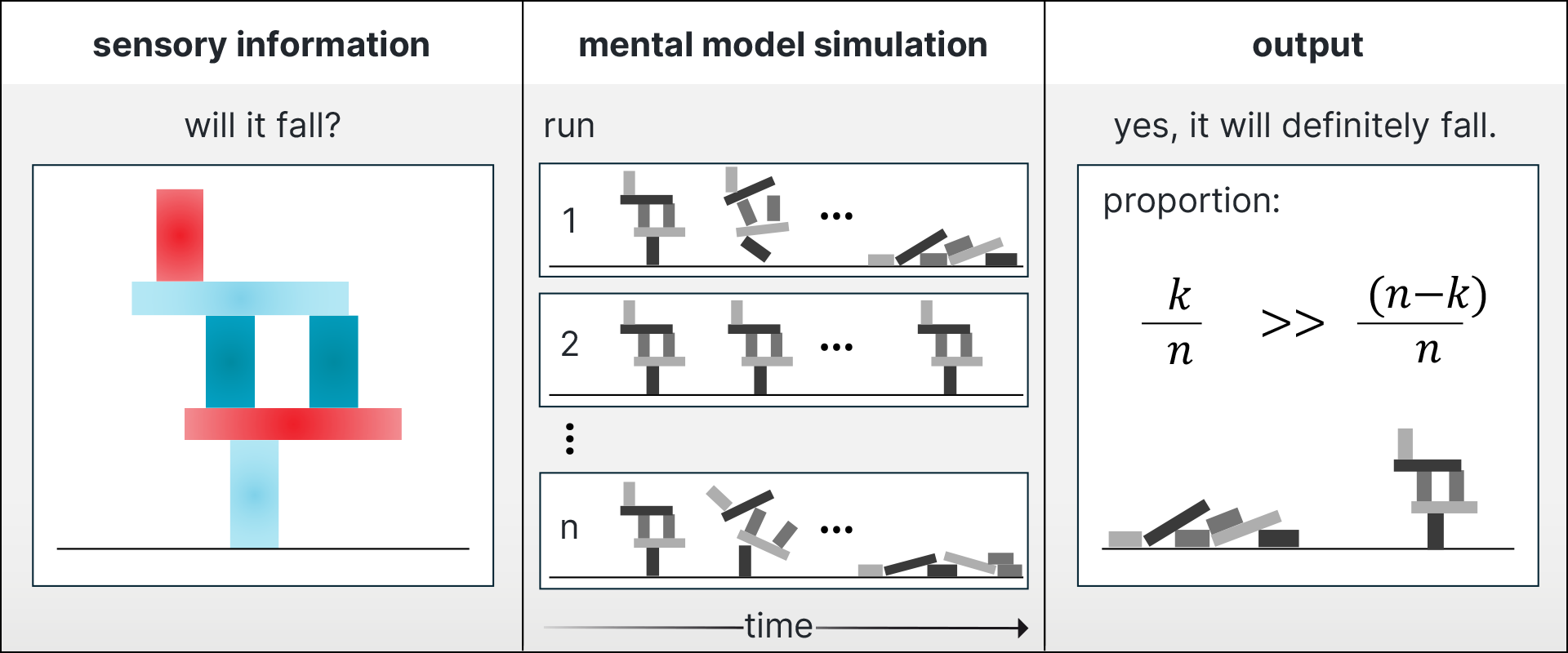
Imagine you are stacking blocks and want to make the tower as tall as possible without causing it to fall. How do you determine whether the tower you constructed will collapse?
First, you take into account the sensory information you are observing, that is, the block configuration itself. According to the model, your mind then runs approximate simulations forward in time, operating over representations of physical properties such as gravity and friction. Each simulation run introduces small random perturbations, reflecting both the uncertainty in your sensory estimates and the inherent noisiness of the simulation process itself. To make a decision, your mind compares the proportion of simulations that result in the blocks collapsing versus those in which the tower remains stable. If most simulations end in collapse, you would judge the tower as unstable.
For theory of mind, computational models formalize how we attribute beliefs, desires, and intentions to other people. The core idea is that we maintain probabilistic estimates of what others know, want, and perceive, and continuously update these estimates as we observe their behavior. The models typically assume that the observed agent acts approximately rationally given its goals, and the observer uses Bayesian inference to work backwards from observed actions to likely mental states. Here is an example:
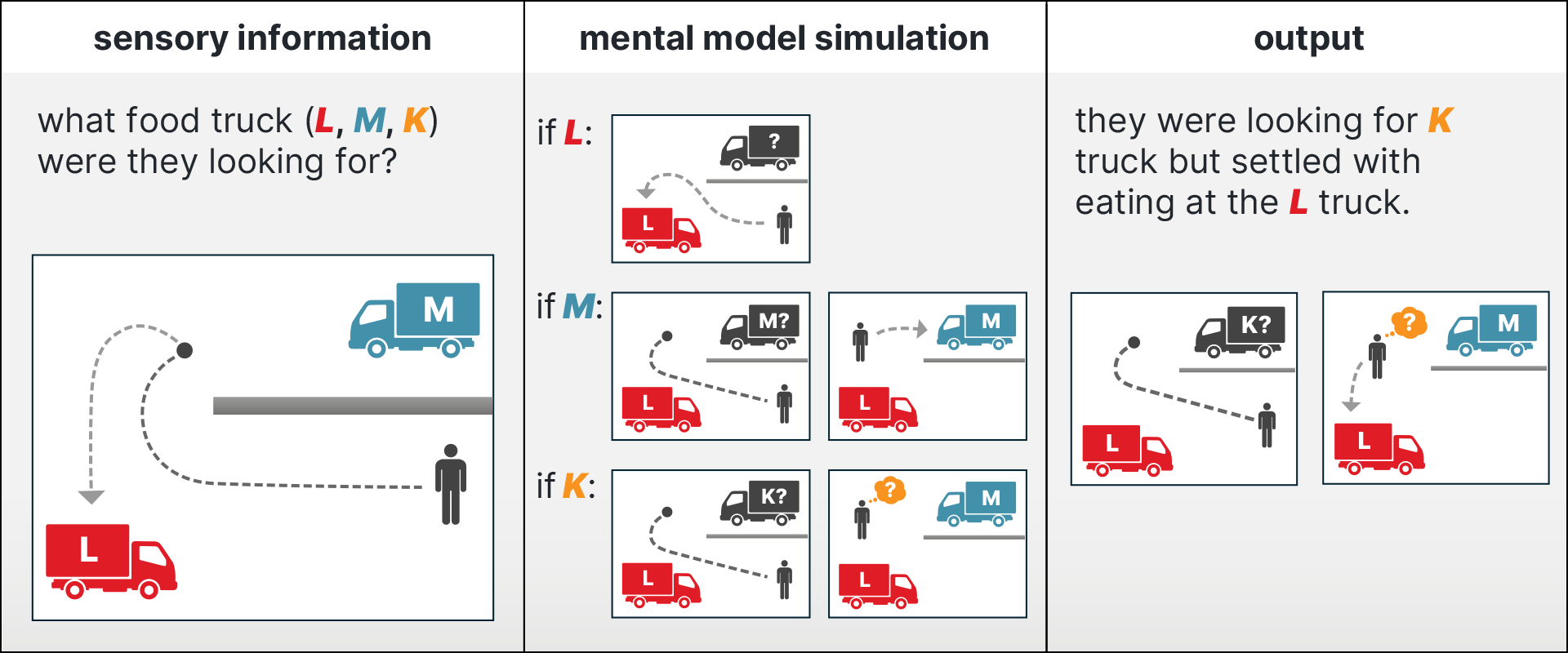
Consider observing an agent navigating a food-truck environment during lunch. You know there are three types of food truck that could be present: Lebanese, Mexican, and Korean.
You want to infer the agent’s desire based on its movements. What you observe is that the agent initially sees the Lebanese truck but does not go to it. Instead, it chooses to look around the corner to identify the second truck. After discovering the Mexican truck, the agent returns and goes to the Lebanese one.
Using your world model of how desires shape rational movement, you can infer that the agent was likely searching for the Korean truck. If it wanted the Lebanese truck, it would have gone there directly. If it wanted the Mexican truck, it would have gone to it after turning the corner. Neither of these fit the observed behavior. What you saw was that the agent rejected both visible options, deliberated, and then settled. This best matches what you would expect if the agent was searching for the Korean truck but, upon failing to find it, ultimately chose the Lebanese one.
For self-perception, recent work has examined how both humans and artificial systems develop models of their own capabilities and states – essentially maintaining a generative model not only of the world, but of the self as an agent within that world. Let’s take a look at how this works:
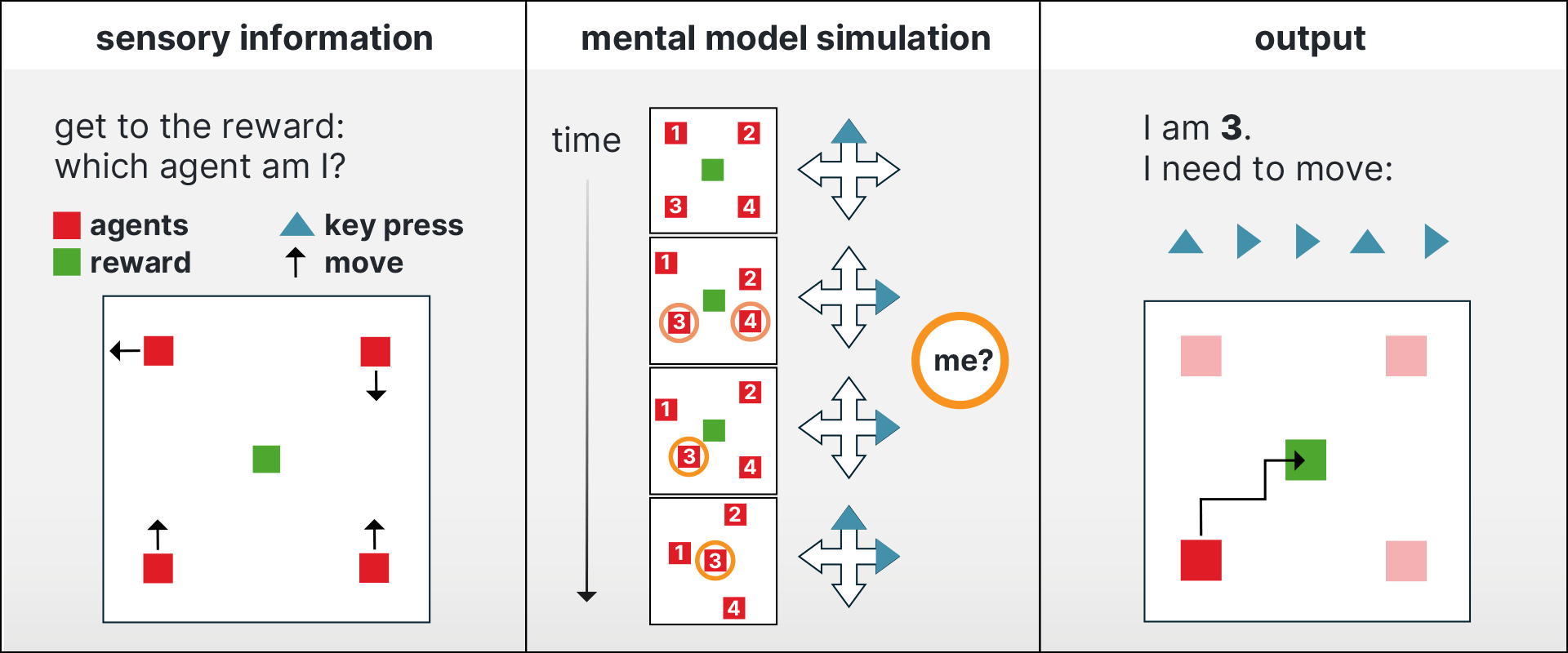
Finally, consider a basic form of self-perception. Suppose you are playing a simple grid-based game in which your goal is to reach a reward, but success requires first identifying which agent in the display corresponds to you.
You observe how the agents move after each of your key presses. Knowing that the agent representing you should respond consistently to your inputs, you can gradually narrow down the candidates. For example, you press the up arrow and observe that two agents move upward. Next, you press the right arrow and observe that only one of those agents moves to the right. This allows you to conclude which agent you are. With this knowledge, you can plan a path to the reward.
This process illustrates how a self-model might work: by comparing predicted consequences of one’s own actions against observed outcomes, an agent identifies itself within a shared environment and uses that knowledge to act effectively.
The common theme across all three domains is that cognition can be described in terms of probabilistic causal models that generate inferences and predictions about events, other agents, and the self. At its core, a probabilistic model specifies a structured hypothesis space describing possible states of the world and the likelihood that each state could have generated the available evidence. It encodes two elements: The common theme across all three domains is that the mind maintains probabilistic causal models and uses them to generate inferences and predictions about events, other agents, and ourselves. At its core, a probabilistic model specifies a structured hypothesis space describing possible states of the world and the likelihood that each state could have generated the available evidence. It encodes two elements:
A generative structure, which captures lawful dependencies among latent variables and describes how observations arise from these hidden causes.
An inference procedure, which updates beliefs about these hidden variables by combining prior expectations with new data according to the rules of probability theory.
The aim of such models is not merely to fit observations but to formalize how a system represents uncertainty, evaluates competing explanations, and revises its model of the world as new evidence arrives. Probabilistic modeling thus provides a framework for describing cognition as the ongoing transformation of uncertain evidence into coherent beliefs.The central aim of such models is not merely to fit observations, but to formalize how an intelligent system represents uncertainty, evaluates competing explanations, and systematically revises its internal model of the world. Probabilistic modelling thus provides a unified framework for describing cognition as the continuous transformation of uncertain evidence into coherent beliefs.
Free Energy Principle and Active Inference
One influential attempt to unify these accounts under a single computational principle is Karl Friston’s free energy principle.
The core idea is that biological systems minimize variational free energy, an upper bound on the improbability of sensory observations given the organism’s internal model. This minimization can be achieved in two ways: by updating internal beliefs to better explain incoming data (perception), or by acting on the world to make sensory input conform to predictions (active inference).
In this framework, perception and action are not separate processes but two expressions of the same computational imperative. The free energy principle has been proposed as a unifying account of brain function, subsuming predictive coding, Bayesian inference, and reinforcement learning as special cases. Whether this generality is a strength or a limitation remains debated.
However, critics have argued that the framework is so broad it risks becoming unfalsifiable (Gershman, 2019), a concern that connects directly to the question of what separates a useful model from a testable theory.
Friston, K. (2010). The free-energy principle: A unified brain theory? Nature Reviews Neuroscience, 11(2), 127–138.
Gershman, S. J. (2019). What does the free energy principle tell us about the brain? Neurons, Behavior, Data Analysis, and Theory, 2(3), 1–10.
Authors: William Palmer & Fabian Mueller
References
Battaglia, P. W., Hamrick, J. B., & Tenenbaum, J. B. (2013). Simulation as an engine of physical scene understanding. Proceedings of the National Academy of Sciences, 110(45), 18327-18332. https://doi.org/10.1073/pnas.1306572110
Baker, C. L., Jara-Ettinger, J., Saxe, R., & Tenenbaum, J. B. (2017). Rational quantitative attribution of beliefs, desires and percepts in human mentalizing. Nature Human Behaviour, 1, Article 0064. https://doi.org/10.1038/s41562-017-0064
De Freitas, J., Uğuralp, A. K., Oğuz-Uğuralp, Z., Paul, L., Tenenbaum, J. B., & Ullman, T. (2023). Self-orienting in human and machine learning. Nature Human Behaviour, 7(12), 2126–2139. https://doi.org/10.1038/s41562-023-01696-5
Tenenbaum, J. B., Kemp, C., Griffiths, T. L., & Goodman, N. D. (2011). How to grow a mind: Statistics, structure, and abstraction. Science, 331(6022), 1279-1285. https://doi.org/10.1126/science.1192788
Lake, B. M., Ullman, T. D., Tenenbaum, J. B., & Gershman, S. J. (2017). Building machines that learn and think like people. Behavioral and Brain Sciences, 40, e253. https://doi.org/10.1017/S0140525X16001837